
Aspartame-Acesulfame Salt E962
Aspartame-Acesulfame Salt is a high-intensity sweetener salt used by food and beverage manufacturers for sugar reduction, calorie reduction and sweetness optimization. It combines the sweetening contribution of aspartame and acesulfame in a single crystalline ingredient, helping formulators design a more sugar-like sweetness curve, improve sweetness efficiency and simplify sweetener-system handling. Industrial evaluation should focus on identity, assay, sweetness profile, solubility, process conditions, phenylalanine labelling, permitted food categories, maximum use levels and destination-market documentation.
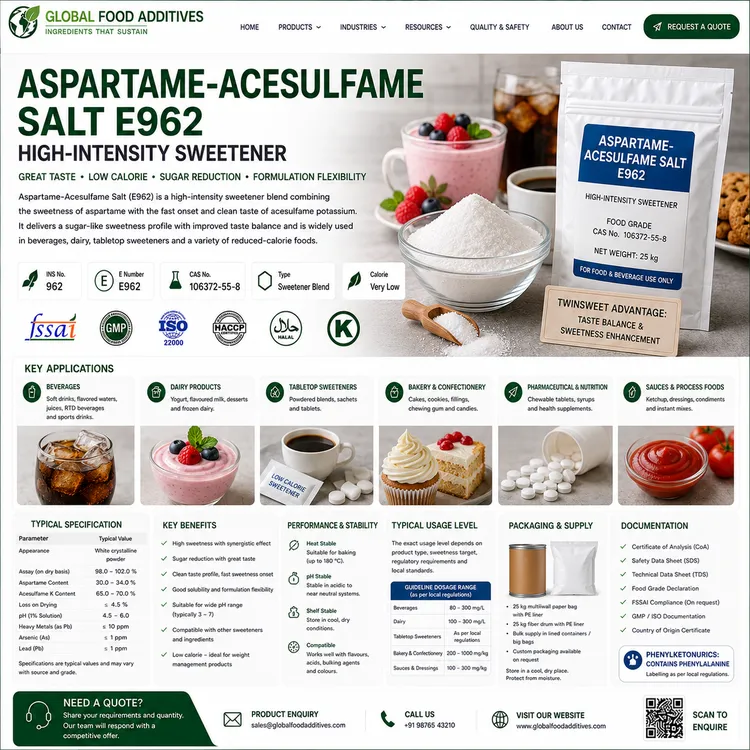
Product identity
| Product | Aspartame-Acesulfame Salt |
|---|---|
| Common names | Aspartame Acesulfame Salt, Salt of Aspartame-Acesulfame, E962, Twinsweet-type sweetener |
| Category | Sweeteners & Polyols |
| Function | High-intensity sweetener / sugar-reduction ingredient / sweetener-system component |
| E / INS number | E962 |
| CAS / identity | 106372-55-8 |
| Chemical family | Salt of aspartame and acesulfame |
| Molecular formula | C18H23N3O9S |
| Molecular weight | Approximately 457.46 g/mol |
| Relative sweetness | Approximately 350 times sweeter than sucrose, depending on matrix, dosage and sensory method |
| Typical form | White to off-white crystalline powder or granular grade |
| Key label point | Contains aspartame-derived phenylalanine; PKU and sweetener labelling must be verified by market |
Application fit
Aspartame-Acesulfame Salt is selected where a manufacturer needs high sweetness intensity, low use level, improved sweetness quality and reduced sugar contribution without adding bulk.
- Carbonated and still low-calorie beverages
- Powdered drink mixes, instant beverages and sachet products
- Tabletop sweeteners and portion-control sweetening systems
- Chewing gum, compressed tablets and breath-freshening products
- Dairy desserts, flavoured milk drinks and chilled dessert systems
- Confectionery, jelly desserts, puddings and fillings where process conditions allow
- Fruit preparations, syrups and low-sugar flavour systems
- Specialty diet, reduced-calorie and sugar-free product development
Technical purchasing notes
When reviewing Aspartame-Acesulfame Salt, compare the supplier specification against the intended food application, sweetness target, processing temperature, pH, storage conditions, shelf-life target, finished-product label requirements and local food additive rules. This ingredient is not a polyol and not a bulking sweetener; it provides sweetness at low dosage but does not replace the solids, body, viscosity, browning, crystallization control, water activity contribution or freezing-point effect of sucrose.
For industrial purchasing, the most useful inquiry normally includes target grade, assay or active content, particle size, solubility requirement, physical form, packaging size, annual quantity, destination country, application type, processing conditions, label declaration requirements and documents required for import or customer approval.
Sweetener technology and formulation role
Aspartame-Acesulfame Salt is used as a high-potency sweetener system where the formulator wants to combine sweetness intensity with a more balanced sensory profile. In many food systems, aspartame contributes a relatively clean sweetness and acesulfame contributes fast sweetness onset and heat-resilient sweetening character. The salt form can help provide a consistent sweetener ratio, simplified dosing and a more integrated sweetness profile compared with handling two separate sweeteners.
Because the ingredient contributes sweetness but almost no bulk at typical use levels, sugar-reduction projects may still require other ingredients to restore mouthfeel, viscosity, solids, acidity balance, flavour carry-through, colour, body or freezing-point behavior. Common supporting ingredients may include fibres, maltodextrin, polyols, hydrocolloids, acids, flavours, bulking systems or other sweeteners, depending on the food category and label strategy.
Formulation advantages
Sweetness profile design
- Supports high sweetness intensity at very low use levels.
- Helps design a more rounded sweetness curve than some single sweeteners.
- Can reduce the need for separate weighing of aspartame and acesulfame potassium.
- Useful where sweetness onset, peak intensity, linger and aftertaste must be balanced.
- Can support flavour systems in cola, citrus, fruit, mint, dairy and confectionery profiles.
Manufacturing convenience
- Single-ingredient handling may simplify sweetener premix preparation.
- Fixed component ratio can support batch-to-batch sweetness consistency.
- Granular grades may improve dosing control in dry blending operations.
- Low dosage can reduce storage space compared with nutritive sweeteners.
- Cost-in-use should be calculated per sweetness unit, not only per kilogram.
Stability and process compatibility
Stability review is essential because Aspartame-Acesulfame Salt contains an aspartame component. While acesulfame potassium is known for good heat stability, aspartame can lose sweetness when exposed to high heat, unsuitable pH, moisture and extended storage conditions. This means the finished sweetener system must be validated in the actual process and not selected only from theoretical sweetness intensity.
- Heat: avoid assuming suitability for high-temperature baking, retort or aggressive thermal processing without pilot trials.
- pH: acidic beverage systems are often more favourable than neutral or alkaline systems, but shelf-life testing is still required.
- Moisture: protect dry powder from humidity to preserve flowability, assay and sweetness performance.
- Storage: verify supplier guidance for temperature, humidity, light exposure and unopened-pack shelf life.
- Blending: confirm compatibility with acids, colours, minerals, preservatives, flavours and bulking systems.
- Finished product: check sweetness retention after processing and through the full distribution shelf life.
Industrial application guidance
Beverages and drink systems
- Relevant for low-calorie carbonated drinks, still beverages, powdered drinks and flavoured water systems.
- Useful where formulators need high sweetness with a balanced onset and reduced aftertaste.
- Requires review of pH, heat treatment, carbonation, preservative system and shelf-life temperature.
- Sweetness should be checked immediately after processing and again after storage.
- Finished labels may require “with sweetener(s)” and phenylalanine-related wording depending on market.
Dry mixes, tablets and confectionery
- Useful in tabletop sweeteners, instant drink powders, compressed tablets and chewing gum systems.
- Particle size, flowability and blend uniformity are critical because the dosage is low.
- Dry premixes should be validated for segregation, dusting, static charge and hot-spot risk.
- Confectionery and filling applications must be checked for heat exposure, water activity and storage stability.
- Bulking, texture and mouthfeel usually require additional formulation support.
Specification checklist for buyers
A professional Aspartame-Acesulfame Salt specification should support identity confirmation, sweetener performance, regulatory compliance and manufacturing consistency. Buyers should request a full technical pack and compare supplier data against the requirements of their finished food category, QA system and import market.
- Assay or purity, including test method and acceptable range
- Identity confirmation by suitable analytical method
- Aspartame content, acesulfame content and component ratio where specified
- Appearance, colour, odour and sensory suitability
- Particle size distribution, bulk density and flowability for dry blending
- Moisture, loss on drying or water content
- pH, solubility and solution clarity where relevant to beverage systems
- Related substances and degradation products, including DKP where specified
- Residual potassium, residual salts or manufacturing residues where relevant
- Heavy metals, arsenic, lead and other elemental impurities where required
- Microbiological limits where applicable to the grade and intended use
- Food-grade statement, allergen declaration, GMO declaration and origin statement
- Halal, kosher, vegan or vegetarian declarations where required by customer or market
- Packaging, shelf life, storage conditions and batch traceability
Quality control and factory handling
Because Aspartame-Acesulfame Salt is used at low dosage, weighing accuracy and distribution uniformity are critical. A small weighing or blending error can create noticeable sweetness variation in the finished product. Manufacturing teams should use calibrated scales, validated pre-blending, controlled addition points, documented mixing times and batch records that trace the sweetener lot to the final production batch.
- Use controlled pre-blending when adding to large dry mixes or seasoning carriers.
- Protect the ingredient from humidity during weighing, transfer and storage.
- Minimize dust generation and follow the supplier safety data sheet for workplace handling.
- Check dissolution or dispersion before release to full-scale beverage production.
- Retain approved reference samples for future supplier and batch comparison.
- Validate sweetness intensity, aftertaste, onset, linger and flavour interaction in the actual food matrix.
Regulatory and labelling review
Aspartame-Acesulfame Salt is identified as E962 in the European additive numbering system, but the correct declaration, food-category permission and maximum use level must be confirmed for each destination market. Buyers should check whether the product must be declared by E number, ingredient name, functional class, “with sweetener(s)” wording, phenylalanine warning, aspartame-related statement or other local consumer information.
Because the ingredient contains an aspartame component, finished products require special review for consumers with phenylketonuria. Claims such as “sugar-free”, “no added sugar”, “diet”, “light”, “low calorie”, “reduced calorie”, “diabetic-friendly”, “keto”, “no artificial sweeteners” or “clean label” should be reviewed against the complete formulation and the rules of the destination country.
Sweetener-system development
Aspartame-Acesulfame Salt can be used as the main sweetener or as part of a broader sweetener system. In commercial product development, formulators often compare it against separate aspartame plus acesulfame K blends, sucralose, neotame, steviol glycosides, saccharin, cyclamate where permitted, polyols and nutritive sweeteners. The correct choice depends on flavour profile, cost-in-use, regulatory acceptance, stability and label strategy.
- Compare sweetness intensity at the intended final dosage, not only in water.
- Evaluate onset, peak sweetness, linger, bitterness, metallic notes and aftertaste.
- Run triangle tests or sensory panels against current sweetener systems where possible.
- Check interaction with acidulants, colours, preservatives, flavour emulsions and minerals.
- Calculate cost per sweetness unit and finished-product cost impact.
- Verify whether the sweetener system changes declaration wording or customer acceptance.
- Complete shelf-life studies under real distribution temperature and packaging conditions.
Packaging, storage and logistics
Aspartame-Acesulfame Salt is commonly supplied in sealed bags, cartons, fibre drums or other moisture-protective packaging depending on supplier and order size. Packaging should be selected according to dosage method, plant humidity, warehouse conditions, shelf-life target, operator handling and container-loading requirements.
- Request net weight, gross weight, pallet configuration and container loading quantity before confirming freight.
- Store in a cool, dry area away from moisture, strong odours and direct sunlight.
- Keep packaging closed after opening and follow the supplier’s recommended re-test or use period.
- Confirm remaining shelf life, production date and batch number before shipment.
- Ask for packing photos, label draft and pre-shipment COA when import clearance or customer approval requires them.
- For export orders, confirm HS code guidance, document legalization needs and destination import requirements.
Documents to request
- Product specification or technical data sheet
- Certificate of analysis for the offered batch or lot
- Safety data sheet where applicable
- Food-grade statement and intended-use declaration
- Origin, manufacturer, shelf-life and storage information
- Allergen, GMO, halal, kosher, vegan or vegetarian declarations where required
- Phenylalanine / PKU labelling guidance where available
- Aspartame and acesulfame component information where included in supplier documentation
- Heavy metal, impurity, related-substance and microbiological information where relevant
- Regulatory compliance statement for the destination country where available
- Label draft, packaging details, pallet configuration and lot-coding format
- Sample COA or historical COA for supplier comparison
- Market-specific declarations required by the buyer, retailer or importing country
How to request this product
Send the product name, target grade or reference specification, final application, expected use level, quantity, destination country, packaging preference, delivery term, expected shipment date and required documents. If you already purchase Aspartame-Acesulfame Salt, attach or describe your existing specification, label, certificate of analysis, approved supplier reference or sweetener-system target so available supplier options can be compared more accurately.
Useful answers
What is Aspartame-Acesulfame Salt used for in food manufacturing?
Aspartame-Acesulfame Salt E962 is used as a high-intensity sweetener for sweetness design, calorie reduction and sugar replacement in beverages, powdered drink mixes, tabletop sweeteners, chewing gum, dairy desserts, confectionery, desserts and other food systems where the additive is permitted.
Is Aspartame-Acesulfame Salt a polyol or bulking sweetener?
No. It is a high-intensity sweetener salt, not a polyol and not a bulk sugar replacer. It provides sweetness at low dosage but does not replace the texture, solids, viscosity, browning, freezing-point depression, water activity or mouthfeel contribution of sugar.
Why use Aspartame-Acesulfame Salt instead of separate sweeteners?
The salt form can provide a fixed sweetener ratio, simplified handling and a balanced sweetness profile. It may help formulators reduce separate weighing steps and improve consistency, but the final decision should be based on cost-in-use, sensory testing, stability and label requirements.
Is Aspartame-Acesulfame Salt suitable for baking?
It should not be assumed suitable for high-heat baking or retort processing because the aspartame component can lose sweetness when heated. If the application involves heat, the buyer should run pilot trials and shelf-life testing under the actual process conditions.
Does Aspartame-Acesulfame Salt require phenylalanine labelling?
Because it contains an aspartame component, finished products should be reviewed for phenylalanine and PKU-related labelling requirements. The exact wording and placement depend on the destination market.
Which documents should be requested?
Buyers commonly request a technical data sheet, product specification, certificate of analysis, safety data sheet where applicable, food-grade statement, origin statement, shelf-life and storage information, allergen and GMO declarations, regulatory statement, label guidance and packaging details.
Can Global Food Additives source Aspartame-Acesulfame Salt?
Global Food Additives can review sourcing options for Aspartame-Acesulfame Salt according to target specification, application, quantity, destination, packaging preference, delivery term and required documentation.
Is this product permitted in every country?
No. Food additive use depends on destination-market rules, food category, use level, labelling requirements, phenylalanine declaration and buyer responsibility. The buyer should verify regulatory status and final suitability before commercial use.
What should be checked during supplier qualification?
Supplier qualification should include identity, assay, component ratio, particle size, solubility, stability data, related substances, degradation products, batch traceability, food-grade documentation, allergen status, regulatory declarations, packaging integrity, lead time, remaining shelf life and export-document support.
Tell us which food additive or ingredient you need.
Send product names, target specifications, quantity, destination country, packaging preference, delivery term, and document requirements. Our team will review your inquiry and respond from orders@foodgradeadditives.com.
Your message has been received. You will be redirected to the home page.