
Disodium 5'-Ribonucleotides E635
Disodium 5'-Ribonucleotides, commonly known in the food industry as I+G, is a food-grade nucleotide flavour enhancer system used to increase umami impact, brothy depth, meaty perception, seasoning roundness, salt perception and flavour persistence. It is widely evaluated in dry seasonings, instant noodles, savoury snacks, soups, bouillons, sauces, meat systems, seafood systems, prepared meals and plant-based savoury formulations.
For industrial buyers, E635 should be reviewed as a high-impact flavour-system ingredient rather than a simple commodity additive. The value of a supplier option depends on assay, I+G ratio, particle size, purity, origin, production route, sensory performance, regulatory permission, label declaration, documentation quality, packaging integrity and batch-level traceability.
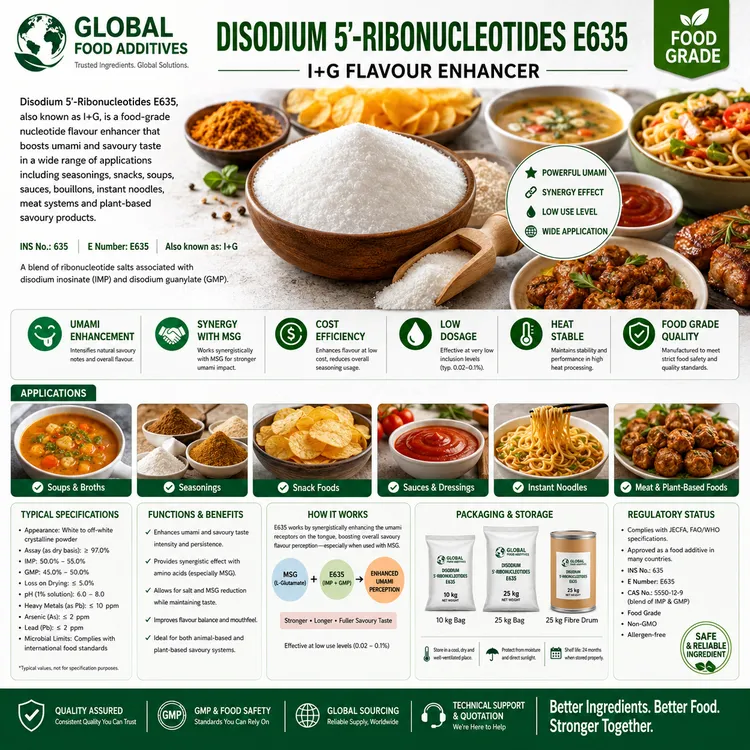
Product identity
| Product name | Disodium 5'-Ribonucleotides |
|---|---|
| Common industry name | I+G |
| Other names | Disodium Ribonucleotides; Disodium 5-Ribonucleotides; IMP + GMP blend |
| Category | Flavour Enhancers & Taste Modifiers |
| Functional class | Flavour enhancer / umami booster / savoury system ingredient / taste modifier |
| E / INS number | E635 / INS 635 |
| CAS / identity | 80702-47-2 |
| Technical composition | Blend of disodium inosinate and disodium guanylate; ratio and active content depend on supplier specification |
| Component relationship | Inosinate component supports meaty and brothy notes; guanylate component supports savoury depth and umami intensity |
| Typical commercial form | White to off-white crystalline powder or granule, depending on supplier and grade |
| Primary technical purpose | Low-dosage intensification of savoury, salty, meaty, brothy and umami flavour systems |
Application fit
Disodium 5'-Ribonucleotides is normally selected where a savoury formulation requires stronger depth and continuity than salt, spices or top-note flavours can provide alone. Potential industrial use areas include:
- Snack seasonings for chips, extruded snacks, crackers, popcorn and coated nuts
- Instant noodle seasoning sachets, soup powders, bouillon cubes and broth concentrates
- Savoury sauces, gravies, marinades, dressings, dips and wet seasoning systems
- Processed meat, poultry, seafood, surimi-style products and ready meals
- Plant-based meat analogues and vegetable-protein savoury systems, subject to origin and claim verification
- Salt-reduction and MSG-optimisation projects where flavour fullness must be maintained
Industrial function and formulation value
Disodium 5'-Ribonucleotides functions as a nucleotide-based flavour enhancer. In savoury food design, it is used to increase umami intensity, improve brothy and meaty character, round saltiness, reduce flavour hollowness and extend the finish of a seasoning system. It is particularly valuable in products where dehydration, extrusion, frying, retorting, pasteurisation, freezing, long storage or cost optimisation can weaken the finished flavour profile.
The ingredient is commonly used in combination with glutamate-rich materials such as monosodium glutamate, yeast extract, hydrolysed vegetable protein, soy sauce powder, mushroom extract, meat extract, fish extract or fermented savoury bases. The formulation goal is usually to build a complete savoury flavour curve: fast first impact, strong middle-body umami, clean salt perception and a longer, rounded aftertaste.
Technical performance considerations
Synergy with glutamate systems
Disodium 5'-Ribonucleotides is most valuable when used with naturally occurring or added glutamate sources. It can significantly increase perceived umami intensity and flavour continuity, but it does not replace the need for a balanced savoury base. Stronger systems usually balance salt, glutamate, nucleotides, yeast extract, acids, sugars, spices, fat, protein notes and process flavours.
Low-dosage flavour design
Because E635 is a high-impact ingredient, dosage should be developed through sensory trials, regulatory review and cost-in-use analysis. Excessive use may create an unbalanced, lingering or artificial savoury note, especially in lightly flavoured products.
Dry-blend behaviour
For seasoning powders and premixes, evaluate particle size, flowability, dusting, caking tendency, bulk density and blend uniformity. Segregation risk should be checked when the formula contains salt, sugar, MSG, starches, acids, spices, anti-caking agents or high-density mineral salts.
Liquid-system behaviour
For soups, sauces, gravies, brines and marinades, confirm dissolution order, mixing time, clarity or haze impact, pH compatibility and stability during hot-fill, pasteurisation, retorting, chilling or frozen storage. The exact performance depends on supplier grade and formulation matrix.
Typical manufacturing applications
| Application area | Technical role | Purchasing and formulation notes |
|---|---|---|
| Snack seasonings | Increases savoury intensity, brothiness and flavour persistence on fried, baked or extruded carriers. | Check blend uniformity, dusting, oil pickup, seasoning adhesion and compatibility with MSG, yeast extract, acids, cheese powders, spices and hydrolysed proteins. |
| Instant noodles and bouillons | Supports broth depth, umami impact, cooked-meat character and seasoning roundness after hot-water preparation. | Evaluate performance after boiling-water addition, holding time, salt level, MSG level, dehydrated vegetables, fat powders and meat-style flavour systems. |
| Sauces and gravies | Improves savoury base notes and helps round acidity, sweetness, saltiness and heat-processed flavour notes. | Confirm dissolution, pH compatibility, heat-process stability, label declaration and interaction with starches, gums, proteins, acids and preservatives. |
| Processed meat and seafood | Enhances meaty, brothy or seafood notes and helps compensate for flavour loss during cooking, chilling, freezing or sterilisation. | Review legal food category, brine compatibility, sodium contribution, thermal process, allergen status and final product sensory profile. |
| Plant-based meat analogues | Builds savoury depth in vegetable-protein systems that can otherwise taste cereal, beany, bitter or flat. | Origin, vegan status and fermentation route must be verified. Test with the protein base, fat system, yeast extract, smoke flavour, masking flavour and spice system. |
| Salt-reduction projects | Can support perceived savouriness and reduce flavour thinness when sodium chloride is reduced. | Should be used as part of a full salt-reduction strategy, not as a direct one-to-one salt replacement. |
Specification points to review before approval
Industrial buyers should compare supplier specifications against internal quality standards, customer requirements, process conditions and destination-market legislation. A robust technical review normally covers:
- Assay or active content: Confirm total nucleotide content, calculation basis, hydrate status and acceptable specification range.
- I+G ratio: Request the declared ratio or component profile of disodium inosinate and disodium guanylate when required by formulation or quality standards.
- Identity testing: Confirm that the product is clearly identified as Disodium 5'-Ribonucleotides / E635 / INS 635 and that the supplier references suitable analytical methods.
- Appearance and physical form: Check colour, odour, crystal form, particle size, bulk density, flowability and suitability for the intended dosing system.
- Moisture or loss on drying: Important for shelf life, caking tendency, premix stability and batch-to-batch consistency.
- pH and solubility: Relevant for soups, sauces, brines, marinades, liquid concentrates and seasoning slurry systems.
- Purity and impurities: Review heavy metals, related substances, residual solvents if applicable and supplier-specific purity limits.
- Microbiology: Confirm total plate count, yeast and mould, pathogens and any category-specific microbiological expectations.
- Origin and production route: Request statements on fermentation, raw-material source, animal-derived materials, processing aids and country of origin.
- Allergen and dietary status: Request allergen, GMO, halal, kosher, vegetarian or vegan documents where required by the final product or customer.
- Packaging and shelf life: Check bag type, liner, net weight, pallet configuration, storage condition and retest or expiry date format.
Regulatory and labelling review
Disodium 5'-Ribonucleotides is identified as E635 / INS 635 and is used as a flavour enhancer in savoury food systems, but permission is not automatic for every country, product type or use level. Before commercial use, the buyer should verify additive status in the destination market, the relevant food category, maximum permitted level, carry-over rules and finished-product labelling requirements.
Depending on local rules, finished product labels may need to declare the additive class and name or number, such as "flavour enhancer: Disodium 5'-Ribonucleotides", "flavour enhancer: E635", "flavour enhancer: INS 635" or a market-specific equivalent. Where products are positioned as vegetarian, vegan, halal, kosher, clean-label, no-MSG-added, reduced-sodium, natural-positioned or child-oriented, additional technical and regulatory review is recommended before approval.
Quality, storage and handling expectations
Storage
Store in tightly closed original packaging in a clean, dry, cool and well-ventilated area. Protect from moisture, odour contamination, direct sunlight and damaged pallets. Humidity control is important for powder grades because moisture can increase caking and reduce dry-premix reliability.
Handling
Powder handling should follow site procedures for dust control, personal hygiene and cross-contamination prevention. Use dedicated or properly cleaned dosing tools when the material is used in allergen-controlled, halal, kosher, vegetarian or vegan production zones.
Incoming inspection
At goods receipt, verify product name, batch number, net weight, packaging condition, shelf life, supplier certificate of analysis and label information. Inspect for caking, moisture ingress, damaged liners, foreign odour or broken pallets before releasing the lot for production.
Traceability
Batch-level traceability should connect purchase order, supplier lot, certificate of analysis, warehouse receipt, internal material code, production batch and finished-product lots. This is especially important for export products, customer audits and recall-readiness programs.
Plant-trial and sensory validation guidance
Before full commercial approval, Disodium 5'-Ribonucleotides should be evaluated in pilot or plant-scale trials using the same ingredients, process sequence, heat treatment, packaging format and shelf-life conditions planned for production. Small bench trials are useful, but they may not reveal all interactions with spice oils, proteins, fats, acids, starches, gums, salt replacers or thermal processing.
- Benchmark the current formula: Compare against the existing flavour system, not only against a blank control.
- Optimise with glutamate source: Test with MSG, yeast extract, hydrolysed protein or natural glutamate ingredients according to the label strategy.
- Evaluate salt perception: Check whether E635 improves savouriness during sodium-reduction trials without creating excessive lingering notes.
- Check aftertaste: Review finish, bitterness, metallic notes, artificial savoury character and flavour persistence after storage.
- Test process stability: Evaluate after baking, frying, boiling-water preparation, hot filling, retorting, freezing or chilled storage as applicable.
- Confirm claim compatibility: Verify origin, dietary suitability and regulatory wording before using the ingredient in claim-sensitive products.
Documents to request
For a professional food-manufacturing approval process, buyers should request documentation that supports identity, safety, compliance, traceability and customer claims. Typical document requirements include:
- Product specification or technical data sheet
- Certificate of analysis for the offered batch or representative lot
- Safety data sheet where applicable
- Food-grade statement and intended-use statement
- Composition, ratio or active-content declaration where required
- Origin statement, manufacturer statement and production-route declaration
- Animal-origin, vegetarian or vegan suitability declaration when required
- Allergen statement and cross-contact information
- GMO status statement, if required by the destination market or customer
- Halal, kosher or other certification documents, if applicable
- Heavy metals, microbiological and purity limits from the supplier specification
- Shelf-life, storage, packaging and pallet-configuration details
- Label draft, bag marking and batch-coding format
- Market-specific declarations required by the importing country, retailer or end customer
Commercial sourcing and logistics notes
Disodium 5'-Ribonucleotides is typically purchased by industrial users according to grade, assay, component ratio, documentation package, origin, batch availability, shipment destination, packaging format and cost-in-use performance. When comparing offers, buyers should not evaluate only the unit price. Flavour impact, ratio consistency, particle size, caking behaviour, documentation quality, lead time, regulatory suitability and plant performance can all affect the real commercial value of the material.
For export projects, buyers should confirm HS code guidance with their customs broker, required import permits, country-specific additive rules, original document requirements, shelf-life remaining at dispatch, pallet treatment, container loading plan and whether the product requires special protection from humidity during transport.
How to request this product
To receive a more accurate quotation, send the product name, target specification, intended food application, annual or spot quantity, destination country, packaging preference, required delivery term, expected shipment date and requested documents. If you already purchase Disodium 5'-Ribonucleotides or I+G, attach your current specification, supplier label, certificate of analysis, component-ratio requirement or benchmark sample details so alternatives can be compared more accurately.
Minimum inquiry details
- Product name: Disodium 5'-Ribonucleotides / I+G / E635 / INS 635
- Required grade and target specification
- Required assay or component ratio, if known
- Quantity per shipment and annual forecast
- Destination country and delivery term
- Preferred packaging size and pallet requirements
- Required certificates and declarations
Helpful technical details
- Application type: seasoning, snack, noodle, soup, sauce, meat, seafood or plant-based product
- Current MSG, yeast extract, hydrolysed protein or savoury-base usage
- Target sensory profile and benchmark product
- Need for salt reduction, MSG optimisation or flavour cost optimisation
- Need for halal, kosher, vegetarian, vegan, allergen or GMO documentation
- Any regulatory market, customer standard or retailer requirement to be matched
Useful answers
What is Disodium 5'-Ribonucleotides used for in food manufacturing?
Disodium 5'-Ribonucleotides E635 is used as a food-grade flavour enhancer in savoury formulations. It supports umami intensity, brothy depth, meaty perception, seasoning roundness, salt perception and overall flavour balance. Exact suitability depends on supplier grade, use level, process, label requirements, regulations and customer documents.
Is Disodium 5'-Ribonucleotides the same as I+G?
Yes. In industrial flavour systems, Disodium 5'-Ribonucleotides is commonly called I+G because it contains inosinate and guanylate nucleotide salts. The exact ratio, assay and quality limits should be confirmed from the supplier specification.
Is Disodium 5'-Ribonucleotides usually used alone?
It is commonly evaluated with glutamate-containing ingredients such as MSG, yeast extract, hydrolysed vegetable protein, soy sauce powder, mushroom powder or meat-style flavour bases. The goal is usually to improve umami impact, savoury continuity and cost-in-use performance.
Which applications are most relevant?
Relevant application areas include dry seasonings, savoury snacks, instant noodles, soups, bouillons, sauces, gravies, marinades, processed meat, seafood products, prepared meals, spice blends and plant-based meat analogues.
Which documents should be requested?
Buyers commonly request a technical data sheet or specification, certificate of analysis, safety data sheet where applicable, composition or ratio declaration, origin statement, production-route statement, allergen statement, GMO statement, halal or kosher documents if required, shelf-life information, storage guidance, label details and packaging configuration.
Is Disodium 5'-Ribonucleotides suitable for vegetarian, vegan, halal or kosher products?
Suitability depends on the exact supplier, raw-material origin, production route, processing aids and certification status. Request supplier declarations before using the product in vegetarian, vegan, halal, kosher or claim-sensitive finished foods.
Is this product permitted in every country?
No. Food additive use depends on destination-market rules, food category, use level, labelling requirements and buyer responsibility. Regulatory approval should be checked before commercial production.
Tell us which food additive or ingredient you need.
Send product names, target specifications, quantity, destination country, packaging preference, delivery term, and document requirements. Our team will review your inquiry and respond from orders@foodgradeadditives.com.
Your message has been received. You will be redirected to the home page.