Broad antimicrobial positioning
LAE is evaluated against selected bacteria, yeasts and moulds depending on the food matrix and target organism. Actual reduction or inhibition must be demonstrated by product-specific challenge testing.
 Global Food AdditivesFood-grade additive sourcing
Ethyl Lauroyl Arginate, commonly abbreviated as LAE and identified in many markets as E243, is a food antimicrobial preservative used for shelf-life design and microbial stability in selected food categories. It is typically evaluated for inhibition of spoilage organisms and food-safety-relevant microorganisms in cooked meats, cheese, sauces, beverages, bakery fillings, dips and surface-treatment systems where local regulations permit. For industrial buyers, the most important review points are active content, assay method, matrix compatibility, pH, water phase, microbial target, dosage limit, label impact, validation requirements and supplier documentation.
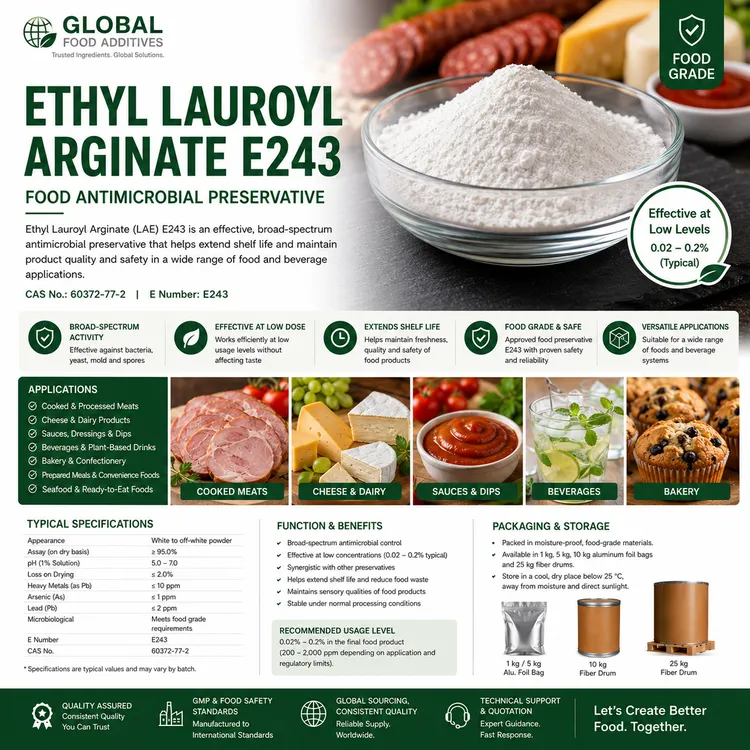
| Product | Ethyl Lauroyl Arginate |
|---|---|
| Common abbreviation | LAE |
| Alternative names | Lauric Arginate, Ethyl Lauroyl Arginate HCl, Ethyl N-alpha-lauroyl-L-arginate |
| Category | Preservatives & Antimicrobials |
| Function | Antimicrobial preservative / shelf-life support / microbial stability ingredient |
| E / INS number | E243 |
| CAS / identity | 60372-77-2 for Ethyl Lauroyl Arginate hydrochloride |
| Chemical family | Amino-acid-derived cationic surfactant antimicrobial |
| Typical form | Powder, granule, liquid solution, formulated blend or surface-treatment preparation |
Potential use areas may include:
Ethyl Lauroyl Arginate is selected when a manufacturer needs an antimicrobial hurdle that can contribute to microbial control without relying only on pH, heat treatment, water activity, cold chain or conventional preservatives. Because LAE is a surface-active cationic molecule, its practical performance depends on how much active compound remains available in the water phase and at microbial cell surfaces. Food manufacturers should evaluate it as part of a complete preservation system that includes formulation design, process hygiene, packaging, storage temperature and validated shelf-life testing.
LAE is evaluated against selected bacteria, yeasts and moulds depending on the food matrix and target organism. Actual reduction or inhibition must be demonstrated by product-specific challenge testing.
It can be combined with other hurdles such as low pH, heat treatment, cold storage, modified-atmosphere packaging, lactates, acetates, sorbates, benzoates or clean-label preservation strategies where permitted.
Because microbial growth normally occurs in available water regions, LAE performance is strongly influenced by dispersion, water activity, pH, fat level, emulsifier system and binding to food components.
LAE should be selected based on the microorganism of concern, expected shelf life, storage temperature, packaging format, distribution chain and finished-product sensory requirements.
Ethyl Lauroyl Arginate can be supplied as a high-active powder, granular material, liquid solution or formulated antimicrobial preparation. The grade should match the dosing method, application matrix, solubility requirement, production line and regulatory status of all carriers or co-ingredients.
| Grade type | Typical purchasing interest | Technical points to verify |
|---|---|---|
| High-active LAE HCl powder | Premix manufacturing, dry blending, concentrated antimicrobial formulations and applications where a defined active assay is required. | Active content, purity, assay method, moisture, particle size, solubility, dusting, SDS classification and packaging barrier. |
| Granular LAE preparation | Reduced dusting, easier handling, improved flow and controlled dosing in industrial plants. | Granule size, friability, active content, dissolution rate, carrier declaration, flowability and homogeneity. |
| Liquid LAE solution | Injection, brine, dip, spray, sauce, beverage or automated dosing systems where liquid addition is preferred. | Active concentration, solvent or carrier system, pH, viscosity, microbial limits, preservative status, storage temperature and shelf life after opening. |
| Formulated antimicrobial blend | Applications requiring synergy with acids, lactates, acetates, flavour systems, buffers or other permitted antimicrobial hurdles. | Complete composition, active contribution, label declaration, allergen status, regulatory status and compatibility with the target matrix. |
| Surface-treatment preparation | Ready-to-eat foods, cooked meats, cheese surfaces or other products where antimicrobial action is focused on the surface. | Application method, pickup level, contact time, residual level, drying, packaging compatibility and local processing-aid or additive classification. |
For industrial purchasing, LAE should be approved through a complete specification review and food-matrix validation. The following checkpoints help procurement, quality assurance, R&D and regulatory teams compare supplier offers.
LAE should be validated in the final food system because antimicrobial activity changes with formulation, process and storage conditions. A practical development programme should include microbial target selection, dosage screening, sensory review, process compatibility, legal level review, packaging trials and shelf-life or challenge-test validation.
LAE can be evaluated in cooked, cured, sliced and ready-to-eat meat systems for surface microbial control and shelf-life support. Validate brine compatibility, surface pickup, residual level, flavour impact, packaging atmosphere and cold-chain performance.
In cheese systems, LAE may be evaluated for surface spoilage control or formulation-level microbial stability where permitted. Test interaction with proteins, salt, fat, cultures, pH and ripening conditions.
Sauces and dips require assessment of pH, oil phase, emulsifier system, gums, starches, spices and salt level. Challenge testing should include yeast, mould and relevant bacterial spoilage organisms.
For beverages and drink bases, evaluate solubility, pH, clarity, precipitation, flavour compatibility, heat treatment and interaction with acids, colours, proteins or anionic stabilizers.
Intermediate-moisture fillings, creams, toppings and glazes should be tested for yeast and mould control, water activity, sugar content, fat phase, flavour impact and thermal process compatibility.
Prepared foods and chilled ready-to-eat products require validation against the expected spoilage flora and safety targets under real packaging and distribution temperatures.
Where permitted, LAE may be evaluated in selected seafood systems or surface applications. Check salt level, proteins, smoke compounds, water activity, sensory impact and regulatory limits.
Surface applications need control of concentration, contact time, pickup, drainage, residual level, drying, packaging and validation of antimicrobial effect at the product surface.
| Technical factor | Why it matters | Practical buyer / R&D action |
|---|---|---|
| Dosage and legal limit | LAE use levels are regulated by market and food category, and excessive use can affect sensory quality. | Confirm maximum permitted level, calculate active contribution and validate lowest effective dose by challenge testing. |
| pH and water activity | Microbial growth and antimicrobial performance depend strongly on pH and available water. | Test LAE at the final product pH, water activity, storage temperature and intended shelf life. |
| Food-matrix interaction | Proteins, fats and anionic ingredients may bind or neutralize cationic antimicrobials. | Run trials in the complete formula, not only in laboratory broth or water solutions. |
| Hurdle combination | LAE may work better as one part of a preservation system rather than as the only control step. | Evaluate combinations with acids, heat, chilled storage, packaging atmosphere, lactates, acetates or other permitted hurdles. |
| Application sequence | Adding LAE before or after heat treatment, homogenization, emulsification or filling can change availability and performance. | Compare addition points and confirm active retention after the full process. |
| Packaging and storage | Modified atmosphere, vacuum packaging, oxygen exposure and temperature abuse can change microbial behaviour. | Validate antimicrobial performance in the final packaging format and distribution chain. |
| Sensory validation | Preservation systems must not create unacceptable bitterness, soapy notes, astringency or mouthfeel changes. | Include trained sensory review and consumer-relevant shelf-life testing before commercial approval. |
| Analytical verification | Some customers or regulators may require confirmation of active level or residual level. | Agree on method, sample preparation, reporting unit and acceptance range before production release. |
Ethyl Lauroyl Arginate should be compared with alternative antimicrobial systems by microbial target, label declaration, sensory impact, process compatibility, legal status and cost-in-use. Do not substitute preservatives without R&D, QA and regulatory approval.
| Preservation option | Typical industrial reason to evaluate | Key difference to check |
|---|---|---|
| Ethyl Lauroyl Arginate E243 | Broad antimicrobial shelf-life support, surface treatment and microbial stability in selected permitted food categories. | Check legal category, active level, matrix binding, sensory impact and challenge-test results. |
| Potassium sorbate / sorbic acid | Yeast and mould control in acidic foods, bakery fillings, beverages and sauces. | Performance is pH-dependent and microbial spectrum differs from LAE. |
| Sodium benzoate / benzoic acid | Preservation of acidic beverages, sauces and liquid products. | Best suited to low-pH systems; label perception and taste impact may differ. |
| Nisin | Natural peptide antimicrobial used in selected dairy, canned and heat-processed foods. | Mainly targets Gram-positive bacteria; activity and permissions differ by market and matrix. |
| Natamycin | Surface mould and yeast control, especially in cheese and selected meat products. | Primarily antifungal; generally used as surface treatment rather than broad bacterial control. |
| Lactates and diacetates | Meat, poultry and ready-to-eat foods requiring shelf-life and pathogen-control support. | Higher use levels, flavour impact, sodium or potassium contribution and different antimicrobial mechanism. |
| Organic acids and acidulants | pH reduction and microbial hurdle support in many food systems. | May change acidity, flavour and product identity; often used with other preservatives. |
LAE should not be approved only from supplier literature or theoretical use levels. Food manufacturers should validate the selected dosage in the actual formulation and packaging. A strong validation plan includes a control sample, one or more LAE levels, target spoilage organisms or pathogens, realistic storage temperature, abuse-temperature scenario where relevant, sensory review and measurement through the full intended shelf life.
Design challenge studies around the microorganisms relevant to the food category, such as yeast, mould, lactic acid bacteria, Listeria, Salmonella or other target organisms identified by the HACCP plan.
Track microbial counts, pH, water activity, sensory quality, texture, colour and package condition through the intended commercial shelf life and distribution conditions.
Compare multiple use levels to identify the lowest effective dose that meets microbial targets without sensory or regulatory concerns.
Confirm that the production process delivers the intended concentration and distribution, especially in sprays, dips, brines, sauces, emulsions and surface applications.
For repeat purchasing, Ethyl Lauroyl Arginate should be approved through a formal supplier qualification process. The buyer should maintain an approved specification, COA history, supplier questionnaire, SDS, regulatory declarations, allergen review, food safety certificates, change-control expectations and application validation records.
Check lot number, manufacturing date, expiry or retest date, active content, identity, moisture, pH, related substances, heavy metals, microbiology and packaging condition before release.
Request traceability from manufacturer to shipment. For export orders, align invoice, packing list, certificate of origin, batch documents and container or pallet references.
Ask whether the production site operates under recognised food safety or quality systems such as HACCP, ISO 22000, FSSC 22000, BRCGS, IFS, GMP or another customer-accepted programme.
For long-term projects, confirm notification expectations for changes in manufacturing site, process route, active specification, carrier system, solvent system, packaging or regulatory documents.
Ethyl Lauroyl Arginate is not permitted for all foods or all countries. Use permissions, food categories, maximum limits, residue limits, label names, additive declarations and processing-aid treatment vary by jurisdiction. Buyers should confirm whether the intended use is allowed in the destination market and whether the compound must be declared as E243, Ethyl Lauroyl Arginate, Lauric Arginate or another local legal name.
Food-grade LAE should be packed to protect the product from moisture, contamination, heat exposure and package damage. Storage requirements depend on whether the material is a powder, granule, liquid solution or formulated blend. Buyers should confirm remaining shelf life, recommended storage temperature, package integrity and handling controls before shipment.
Common options may include foil-lined bags, fibre drums, cartons or smaller sealed packs depending on grade, activity level and order quantity. Confirm net weight, liner and tamper evidence.
Liquid grades may be supplied in bottles, jerrycans, drums or IBCs. Confirm active concentration, solvent system, storage temperature, microbial limits and shelf life after opening.
Store tightly closed in a cool, dry, clean area away from direct sunlight, humidity, strong odours and incompatible materials. Follow supplier SDS and first-in-first-out rotation.
For international shipments, align product description, HS code guidance, certificate of origin, SDS, food-grade statement, shelf-life remaining and destination-specific import documents.
Send the product name, target active content, physical form, application, target microorganism if known, intended use level, destination country, quantity, packaging preference, expected shipment date, Incoterms and required documents. If you already purchase Ethyl Lauroyl Arginate, attach or describe your current specification, COA, formulation, use level, challenge-test target or finished-product standard so supplier options can be compared accurately.
Example: “We need food-grade Ethyl Lauroyl Arginate / LAE, E243, CAS 60372-77-2, target active content required, powder or liquid grade, application: cooked meat / cheese / sauce / beverage / bakery filling, target shelf life and microbial concern, quantity: 25 kg trial or annual contract, destination: EU / GCC / USA / Africa, required documents: TDS, COA, assay method, SDS, food-grade statement, regulatory declaration, allergen statement, GMO statement, halal certificate, origin certificate, microbiological specification and shelf-life declaration. Please quote FOB / CIF / CFR with lead time.”
Ethyl Lauroyl Arginate is used as an antimicrobial preservative for microbial stability, shelf-life support, yeast and mould control, bacterial inhibition and surface-treatment concepts in permitted food categories. Exact suitability depends on grade, dosage, food matrix, process, storage, regulations and supplier documents.
LAE is a common abbreviation for Ethyl Lauroyl Arginate or Lauric Arginate. Commercial food grades are often supplied as the hydrochloride salt, depending on supplier specification.
In markets using E-number terminology, Ethyl Lauroyl Arginate is identified as E243. Buyers should still confirm the local legal name and permitted use conditions for the destination country.
LAE is often evaluated in cooked meat, cured meat, poultry and ready-to-eat meat systems where permitted. Validation should include surface distribution, use level, microbial challenge testing, sensory impact and packaging conditions.
LAE may be evaluated in selected beverages, sauces, dips and liquid systems where local rules permit. Key checks include pH, solubility, clarity, flavour, emulsion stability, gum interaction and target microorganisms.
Not automatically. These preservatives have different microbial spectra, legal permissions, pH dependence, sensory profiles and label impacts. Replacement should be validated by R&D testing and regulatory review.
Buyers commonly request a technical data sheet, approved specification, certificate of analysis, assay method, safety data sheet, food-grade statement, regulatory declaration, impurity statement, microbiological specification, contaminant declaration, shelf-life information and packaging details.
Global Food Additives can review sourcing options for Ethyl Lauroyl Arginate according to target active content, grade, physical form, application, quantity, destination, packaging, lead time and required documentation.
No. Permissions, maximum use levels, food categories, additive declaration, processing-aid treatment and antimicrobial claims depend on destination-market legislation, final formulation, use level and customer responsibility.
Send product name, target active content, physical form, application, quantity, destination country, packaging preference, delivery term and document requirements. Our team will review your inquiry and respond from orders@foodgradeadditives.com.