
Glucono Delta Lactone E575
Glucono Delta Lactone, commonly abbreviated as GDL, is a food-grade controlled-acidification ingredient used where manufacturers need gradual pH reduction, mild acid development, protein gelation, sequestration, leavening support and improved process consistency. Because GDL slowly converts to gluconic acid in aqueous systems, it is especially valuable in applications where direct addition of a fast acid may create harsh flavour, uneven coagulation, localised protein shock or unstable texture.
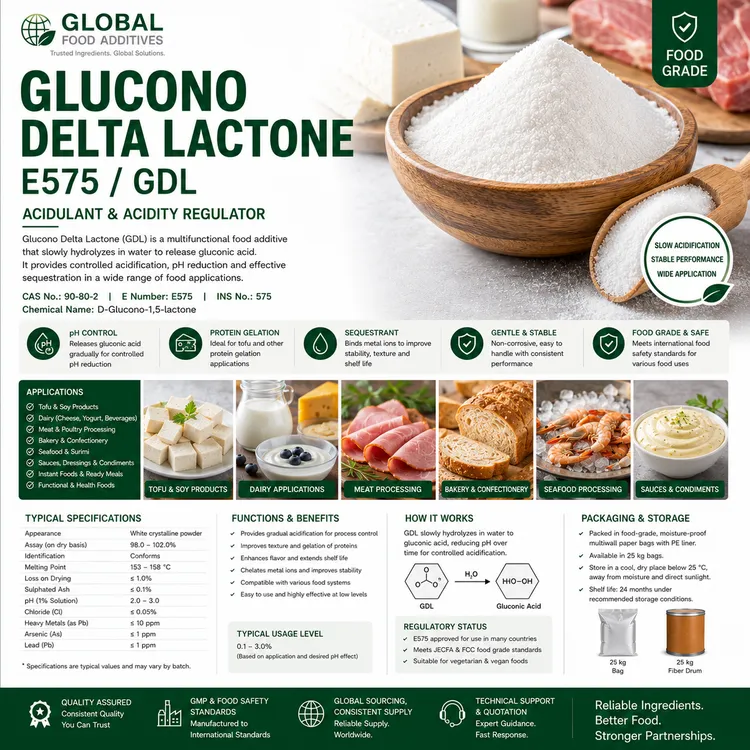
Product identity
| Product | Glucono Delta Lactone |
|---|---|
| Common abbreviation | GDL |
| Synonyms | Glucono-delta-lactone, D-gluconic acid delta-lactone, D-glucono-1,5-lactone, gluconolactone |
| Category | Acidulants & Acidity Regulators |
| Function | Acidity regulator / pH control agent / acidulant / sequestrant / controlled acidification ingredient |
| E / INS number | E575 / INS 575 |
| CAS / identity | 90-80-2 |
| Molecular formula | C6H10O6 |
| Typical form | White to off-white crystalline powder or granule, depending on supplier grade |
| Key characteristic | Gradual hydrolysis to gluconic acid for controlled pH decrease |
Application fit
Potential use areas may include:
- Tofu and soy-protein coagulation systems
- Dairy gels, cheese-style products and cultured-style dairy systems
- Bakery mixes and controlled leavening systems
- Meat, poultry and seafood processing where pH control is required
- Sauces, dressings, marinades and condiment systems
- Beverages requiring smoother acidity development
- Confectionery, fillings and fruit preparations
- Ready meals and prepared foods requiring formulation-level pH management
Technical overview
Glucono Delta Lactone is the cyclic ester of D-gluconic acid. In the presence of water, it gradually hydrolyses into gluconic acid, creating a controlled acidification profile rather than an immediate sharp pH drop. This behaviour can help food technologists manage gel formation, protein network development, microbial hurdle design, flavour smoothness, buffering response and final product consistency.
In industrial production, GDL is normally selected not only for its chemical identity but also for its performance curve inside the customer’s actual process. Important variables include water activity, temperature, hydration time, mixing intensity, protein concentration, mineral balance, buffering capacity, sodium or calcium content, target final pH, hold time, heat treatment and packaging conditions.
Functional performance in food systems
Controlled acidification
GDL can reduce pH progressively as it hydrolyses. This is valuable in protein-containing systems where controlled acid release may support smoother coagulation, better gel uniformity and lower risk of coarse or brittle texture.
Protein gelation
In soy, dairy and mixed-protein systems, GDL is often evaluated as a slow acidifier that helps proteins approach their isoelectric region in a more controlled way. The result may influence curd strength, water retention, syneresis, mouthfeel and cut quality.
Sequestration and buffering support
GDL and the gluconate system can contribute to metal-ion management and pH buffering behaviour in selected formulations. This can be relevant in sauces, dressings, beverages, seafood systems and mineral-sensitive recipes.
Flavour management
Because acid development is gradual, GDL can deliver a milder acid perception than immediately dosed strong acids. In finished products, sensory impact depends on dosage, final pH, sweetness, salt level, protein matrix and flavour system.
Typical industrial applications
| Application area | Technical role | Purchasing notes |
|---|---|---|
| Tofu and soy protein products | Slow acidification and protein coagulation for smooth curd development. | Check particle size, dissolution behaviour, final pH target, curd strength and water release. |
| Dairy and cheese-style systems | Controlled acid development for gelation, texture formation and pH adjustment. | Trial against milk solids, protein level, calcium balance, heat treatment and desired texture. |
| Bakery and dry mixes | Acid component for leavening reactions and pH control in dry systems. | Review particle size, blending uniformity, reaction timing and compatibility with bicarbonate systems. |
| Processed meat and seafood | pH adjustment, curing or pickling support and formulation-level acidification. | Verify permitted use, target pH, protein functionality, water binding, colour impact and label requirements. |
| Sauces, dressings and condiments | Acidity regulation, flavour balance and pH stability. | Evaluate against salt, sugar, starch, gums, emulsifiers, preservatives and heat process. |
| Beverages and fruit systems | Soft acidification and taste balancing where immediate sharp acid impact is not desired. | Check solubility, clarity, final acidity, mineral content and compatibility with flavours or colours. |
Formulation and process considerations
- Hydrolysis rate: acidification speed is influenced by temperature, pH, concentration, water availability and processing time.
- Mixing quality: uniform dispersion is important to prevent localised acidification, uneven coagulation or texture defects.
- Buffering capacity: high-protein, high-mineral or phosphate-containing systems may require trials to determine practical dosage.
- Final pH: buyers should define the target pH range, measurement temperature and sampling point in the process.
- Particle size: granulation and powder flow can influence dry blending, dissolution, dusting and dosing precision.
- Heat treatment: thermal steps may accelerate acid release and change texture development or reaction timing.
- Sensory impact: final sourness is affected by pH, titratable acidity, sweetness, salt, flavour system and food matrix.
Technical purchasing notes
When reviewing Glucono Delta Lactone, compare the supplier specification against the intended food application, process conditions, target function, label expectations and local rules. For industrial purchasing, the most useful inquiry normally includes target grade, assay or active content, physical form, particle size preference, packaging size, annual volume, trial quantity, destination country, delivery term and document requirements.
For critical manufacturing projects, customers should request a representative specification and trial batch before commercial approval. Practical testing should compare pH curve, dissolution time, sensory profile, gel strength, syneresis, final texture, microbial criteria, shelf-life performance and compatibility with other ingredients in the formulation.
Specification points to compare
| Parameter | Why it matters |
|---|---|
| Assay / purity | Confirms active ingredient level and consistency against the buyer’s reference standard. |
| Appearance and colour | Important for dry blends, light-coloured products and visible ingredient quality control. |
| Moisture or loss on drying | Affects flowability, caking tendency, shelf life and active concentration. |
| Particle size distribution | Influences dissolution speed, dry blending uniformity, dusting and dosing accuracy. |
| pH behaviour | Helps predict acidification curve and final process performance. |
| Heavy metals and impurities | Required for food safety, import clearance and customer quality systems. |
| Microbiological criteria | Relevant for ready-to-eat foods, dairy, beverage and sensitive applications. |
| Packaging integrity | Protects against moisture uptake, contamination, damage and caking during transport. |
Documents to request
- Product specification or technical data sheet
- Certificate of analysis for available batch or lot
- Safety data sheet where applicable
- Food-grade statement and intended-use declaration
- Allergen, GMO, vegan, halal or kosher statements where required
- Origin, manufacturer, shelf-life and recommended storage information
- Heavy metals, microbiology and contaminant declarations when required by the buyer
- Label draft, packaging details, net weight, gross weight and pallet configuration
- Market-specific declarations for the destination country
- Import documents, commercial invoice, packing list and certificate of origin when applicable
Packaging, storage and logistics
Food-grade GDL is commonly supplied in sealed bags, cartons, drums or palletised industrial packaging depending on supplier capability and order size. Because dry acidulants can be sensitive to moisture pickup and caking, packaging should protect against humidity, broken seals and contamination. Store in a cool, dry, well-ventilated area, away from strong odours, incompatible chemicals and direct moisture exposure.
For export inquiries, buyers should specify preferred Incoterms, destination port or delivery address, target shipment date, required shelf life on arrival, pallet restrictions, language requirements for labels and whether the shipment requires halal, kosher, certificate of origin or other customs documentation.
Quality and supplier qualification
For recurring industrial purchases, supplier approval should include document review, sample testing, trial production and batch-to-batch comparison. Buyers may also request information about manufacturing site standards, food safety certification, traceability, recall procedure, change-control policy and lead-time reliability. Where the product is used in sensitive processes such as tofu, dairy gels or dry leavening mixes, the same chemical identity may still perform differently if particle size, moisture or dissolution profile changes.
How to request this product
Send the product name, target grade or reference specification, quantity, destination country, packaging preference, expected shipment date and required documents. If you already purchase Glucono Delta Lactone, attach or describe your existing specification, label or certificate of analysis so supplier options can be compared more accurately.
Best inquiry details
- Product name: Glucono Delta Lactone / GDL / E575
- Required grade and reference standard
- Target application and food category
- Annual demand and first-order quantity
- Packaging size and pallet preference
- Destination country and delivery term
- Required documents and certifications
Application questions to include
- Target pH and measurement point
- Process temperature and hold time
- Dry blend or liquid dosing method
- Protein, mineral or buffer level in the formula
- Texture, gel strength or sensory target
- Any restricted ingredient or label requirement
Useful answers
What is Glucono Delta Lactone used for in food manufacturing?
Glucono Delta Lactone is used for controlled acidification, pH control, sequestration, leavening support, tofu coagulation, protein gelation, flavour balance and process stability. Exact suitability depends on grade, food category, process conditions, target pH, local regulations and supplier documents.
Why do manufacturers choose GDL instead of adding acid directly?
GDL gradually hydrolyses to gluconic acid in water. This delayed release can help manufacturers achieve smoother acidification, more uniform protein coagulation and lower risk of localised pH shock compared with direct acid addition. Practical results must be validated in the customer’s formulation.
Is GDL suitable for tofu and dairy systems?
GDL is widely evaluated in soy and dairy-type systems where controlled acidification can support gel formation. The final texture depends on protein concentration, heat treatment, mineral balance, dosage, hydration time, temperature and mixing method.
Which documents should be requested?
Buyers commonly request a technical data sheet or specification, certificate of analysis, safety data sheet where applicable, origin statement, shelf-life information, allergen and GMO statements, halal or kosher certificates, label and packing details, and market-specific declarations.
Can Global Food Additives source Glucono Delta Lactone?
Global Food Additives can review sourcing options for Glucono Delta Lactone according to target specification, quantity, destination, packaging and required documentation.
Is this product permitted in every country?
No. Food additive use depends on destination-market rules, food category, use level, label requirements and buyer responsibility. Always verify regulatory status in the intended market before commercial use.
Tell us which food additive or ingredient you need.
Send product names, target specifications, quantity, destination country, packaging preference, delivery term, and document requirements. Our team will review your inquiry and respond from orders@foodgradeadditives.com.
Your message has been received. You will be redirected to the home page.