
Glycerol Monostearate
Glycerol Monostearate, commonly abbreviated as GMS and also known as glyceryl monostearate or monostearin, is a widely used food emulsifier and surface-active ingredient within the mono- and diglycerides of fatty acids family. It is selected by manufacturers for emulsion stability, aeration, foam support, fat dispersion, starch complexing, crumb softness, anti-staling performance, texture control and processing tolerance. This page is prepared as an industrial sourcing guide for grade selection, specification review, document collection, production validation and quotation requests.
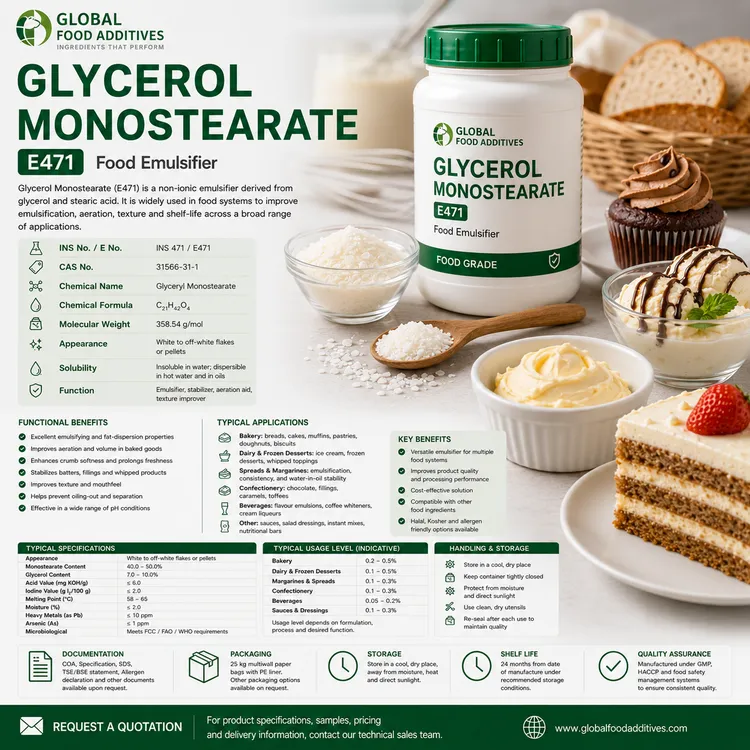
Product identity
| Product | Glycerol Monostearate |
|---|---|
| Common names | Glyceryl Monostearate, Glycerin Monostearate, GMS, Monostearin, Distilled Monoglycerides, Mono- and Diglycerides of Fatty Acids |
| Category | Emulsifiers & Surface Active Ingredients |
| Function | Emulsifier, surface-active ingredient, aeration aid, fat-dispersion support, crumb softener, anti-staling ingredient, foam stabilizer and texture modifier |
| E / INS number | E471 where permitted and applicable |
| CAS / identity | 31566-31-1 |
| Typical form | Powder, bead, flake, pellet, paste, block or liquid dispersion depending on grade and application |
| Typical grade types | Distilled monoglyceride, non-distilled mono- and diglyceride, high-alpha monoglyceride, self-emulsifying grade, hydrated grade or application-specific blend |
| Industrial buying focus | Monoglyceride content, alpha-monoglyceride level, fatty acid profile, source oil, melting point, acid value, iodine value, saponification value, free glycerol, peroxide value, particle size, odour, colour, halal/kosher status and regulatory declarations |
Application fit
Glycerol Monostearate is selected when a manufacturer needs improved fat-water interaction, controlled crystallization, foam or aeration support, softer crumb, better dispersion, improved emulsion tolerance or more stable texture through processing and storage.
- Bakery, bread, buns, cakes, sponge systems and premixes
- Margarine, spreads, shortenings and fat-based systems
- Ice cream, frozen desserts, whipped toppings and dairy emulsions
- Coffee whiteners, creamers and powdered beverage bases
- Chocolate, compound coatings and fat-based confectionery systems
- Sauces, dressings, fillings, desserts and ready-meal emulsions
- Starch-based foods, instant powders and aerated mixes
Technical purchasing notes
When reviewing Glycerol Monostearate, compare the supplier specification against the intended food application, fat phase, water phase, process temperature, shear conditions, cooling profile, pH, solids content, label expectations and local food additive rules. For industrial purchasing, the most useful inquiry includes target grade, monoglyceride content, physical form, source oil, packaging size, quantity, destination and document requirements.
GMS is amphiphilic: it contains a lipophilic fatty acid chain and a hydrophilic glycerol head group. This structure allows it to orient at fat-water interfaces, influence fat crystal networks, interact with starch, support aeration and improve dispersion in many processed foods. In bakery, it is often evaluated for crumb softness and anti-staling. In whipped and aerated products, it supports air incorporation and foam stability. In fat systems, it can influence emulsion stability, crystallization and texture.
Specification parameters to compare
| Parameter | Why it matters industrially | What to request from supplier |
|---|---|---|
| Monoglyceride content | Higher monoglyceride content generally gives stronger surface activity and more consistent functionality in bakery, aeration and emulsion systems. | Monoglyceride percentage, alpha-monoglyceride level if available, test method and COA value. |
| Distilled vs non-distilled grade | Distilled grades usually have higher monoglyceride purity and more predictable performance. Non-distilled grades may be suitable for cost-sensitive or less demanding applications. | Grade type, purity profile, recommended applications and performance data. |
| Fatty acid profile | Stearic, palmitic, oleic and other fatty acid ratios affect melting point, crystallization behaviour, emulsion performance, mouthfeel and source declarations. | Fatty acid composition, source oil declaration and animal/vegetable origin statement. |
| Iodine value | Indicates degree of unsaturation and affects oxidation stability, melting behaviour, fat compatibility and storage quality. | Iodine value range, method and lot-specific COA result. |
| Acid value | High acid value can indicate free fatty acids and may affect odour, flavour, stability and customer acceptance. | Acid value specification, method and COA result. |
| Saponification value | Supports identity confirmation and indicates average ester composition of the material. | Saponification value range and analytical method. |
| Melting point / drop point | Important for fat-phase incorporation, bakery mixing, coating systems, spreads, ice cream mixes and processing temperature design. | Melting range or drop point, method and recommended use temperature. |
| Free glycerol | Free glycerol can affect taste, texture, water activity, crystallization and performance consistency in sensitive applications. | Free glycerol limit, method and COA value. |
| Peroxide value | Indicates oxidation status and is important for fat-based, dairy, bakery and flavour-sensitive formulations. | Peroxide value limit, COA value and storage recommendation. |
| Particle size and physical form | Powder, bead, pellet and flake grades disperse differently and can affect melting time, dusting, dosing accuracy and blend uniformity. | Particle size, mesh, physical form, bulk density and handling recommendations. |
| Colour and odour | Important for white bakery mixes, dairy systems, creamers, coatings and sensory-sensitive products. | Appearance specification, odour description, sensory standard and retain sample policy. |
| Heavy metals and contaminants | Required for food safety, export documentation, customer specifications and supplier approval. | Lead, arsenic, cadmium, mercury and relevant contaminant limits with COA or declaration. |
| Source oil and dietary status | E471 materials may be sourced from vegetable oils or animal fats; this affects halal, kosher, vegetarian, vegan and customer-label requirements. | Origin statement, source oil declaration, halal/kosher certificate and animal-free statement where required. |
| Batch traceability | Essential for supplier approval, audits, complaint handling, export documentation and recall systems. | Lot number, production date, expiry or retest date, origin, manufacturer name and packing list. |
Application guidance by industry
| Industry / application | Technical role | Key validation points |
|---|---|---|
| Bread, buns and yeast-raised bakery | Supports crumb softness, anti-staling, gas-cell stability, dough tolerance and starch-complexing effects. | Flour quality, dough temperature, mixing time, fermentation, proofing, loaf volume, crumb softness, shelf life and compatibility with enzymes or DATEM/SSL blends. |
| Cakes, sponge and aerated batters | Improves aeration, batter stability, volume, crumb uniformity and tolerance in industrial cake lines. | Emulsifier activation, premix design, batter specific gravity, whipping time, baking profile, collapse risk and final crumb structure. |
| Margarine, spreads and shortenings | Helps stabilize water-in-oil systems, influence fat crystal structure, improve plasticity and support spreadability. | Fat blend, water phase, cooling profile, crystallization, salt level, emulsifier blend, plasticity and oiling-out behaviour. |
| Ice cream and frozen desserts | Supports fat destabilization control, aeration, dryness, melt resistance, body and texture in combination with stabilizers. | Homogenization, ageing time, overrun, meltdown curve, heat-shock stability, stabilizer blend, fat content and sensory smoothness. |
| Whipped toppings and aerated creams | Supports foam formation, air-cell stabilization and controlled fat agglomeration. | Whipping time, overrun, foam stability, syneresis, fat phase, cooling profile, shear sensitivity and storage stability. |
| Coffee whiteners and powdered beverages | Supports fat dispersion, emulsion stability, powder reconstitution and creaming control in selected systems. | Oil type, caseinate/protein system, homogenization, spray drying, powder flow, wettability, whiteness and cup stability. |
| Chocolate and compound coatings | Can be evaluated for fat-phase behaviour, dispersion support and processing compatibility, although formulation role should be compared against lecithin, PGPR and other chocolate emulsifiers. | Viscosity, yield value, fat bloom, tempering, particle dispersion, flavour impact and regulatory fit for the target product standard. |
| Sauces, fillings and ready meals | Helps stabilize fat dispersion, improve mouthfeel, reduce separation and support process tolerance in selected emulsified systems. | pH, salt, oil level, starch/protein system, heat treatment, shear, retort or pasteurization conditions and storage stability. |
Processing and formulation considerations
- Select the correct grade. Define whether the application requires distilled monoglyceride, non-distilled mono- and diglycerides, high-alpha GMS, self-emulsifying GMS, hydrated GMS or an application-specific blend.
- Match the emulsifier to the fat phase. Performance depends on fat source, melting profile, saturation level, oil content and crystallization behaviour. Test with the exact fat or oil used in production.
- Control melting and activation. Many GMS grades perform best when melted into the fat phase or properly activated in a pre-emulsion. Incomplete melting can create specks, poor dispersion and inconsistent functionality.
- Manage cooling and crystallization. In spreads, shortenings, coatings and frozen desserts, cooling rate and crystal form can strongly influence texture, stability and sensory quality.
- Validate water-phase interactions. Some grades can form hydrated structures or alpha-gel systems that affect aeration, foam stability and crumb softness. Confirm hydration method and process sequence.
- Check compatibility with other emulsifiers. GMS is often used with lecithin, SSL, CSL, DATEM, polysorbates, PGPR, sorbitan esters or sucrose esters depending on product type. Optimize the blend rather than evaluating GMS alone.
- Approve the regulatory position. Confirm permitted use, maximum level, food category, label declaration, source-oil status and customer restrictions in the destination market before commercial production.
For R&D teams
Request samples from multiple grades and test in the real formula. Compare emulsification, aeration, crumb softness, melt resistance, fat dispersion, viscosity, sensory impact, processing tolerance and shelf-life stability.
For QA teams
Build an approval file covering identity, E471 status, CAS number, monoglyceride content, source oil, food-grade declaration, COA format, contaminants, allergens, GMO status, halal/kosher status and traceability.
For procurement teams
Compare offers by grade, monoglyceride content, source, physical form, packaging, minimum order quantity, lead time, shelf life, pallet configuration, documentation quality and supplier continuity.
For production teams
Confirm melting temperature, dosing point, pre-blending method, fat-phase incorporation, mixing shear, cooling profile, dust control, line cleaning and warehouse conditions before scale-up.
Quality-control and incoming inspection
A practical incoming inspection plan for Glycerol Monostearate should include document review, packaging inspection, lot number verification, appearance check, odour check, melting behaviour, monoglyceride content review and source-oil verification. For high-volume bakery, dairy and fat-system applications, maintain an internal reference sample and compare new lots against an approved benchmark.
- Visual check: confirm white to off-white appearance, absence of foreign matter, caking, melted lumps, oiling-out or moisture damage.
- Odour check: verify neutral fatty odour and absence of rancid, burnt, solvent-like or stale notes.
- Melting check: compare melting behaviour against the approved grade for production consistency.
- COA review: verify monoglyceride content, acid value, iodine value, saponification value, peroxide value and free glycerol where specified.
- Application check: run a small bakery, emulsion, fat-system or aeration test when the application is performance-critical.
- Dietary check: confirm vegetable origin, halal, kosher, vegetarian or vegan status when required by customer or market.
Recommended documentation package
A complete industrial sourcing file for Glycerol Monostearate should support supplier approval, import clearance, customer documentation, regulatory review and batch release.
- Product specification or technical data sheet
- Certificate of analysis for offered batch or representative lot
- Food-grade declaration
- E471 regulatory statement where applicable
- CAS 31566-31-1 identity confirmation
- Monoglyceride and diglyceride content
- Alpha-monoglyceride level where available
- Fatty acid profile
- Vegetable or animal source declaration
- Palm, non-palm or RSPO-related statement where required
- Acid value, iodine value and saponification value
- Free glycerol and peroxide value
- Heavy metals and contaminant statement
- Residual catalyst or solvent statement where applicable
- Safety data sheet where applicable
- Allergen declaration
- GMO statement
- Halal certificate where required
- Kosher certificate where required
- Vegan or vegetarian statement when needed
- Origin and manufacturer statement
- Shelf-life and storage recommendation
- Label draft and packaging details
- Pallet configuration and net/gross weight
- Country-of-origin and export documentation
Storage, handling and packaging
Glycerol Monostearate should be stored in original sealed packaging in a clean, dry and well-ventilated warehouse. Protect the product from moisture, direct sunlight, excessive heat, dust, pests and strong odour sources. Because GMS is fat-based, poor storage can affect odour, oxidation status, caking, flowability and processing performance.
Typical packaging may include PE-lined paper bags, cartons, fibre drums, boxes, pails, blocks, bags on pallets or bulk packaging depending on physical form and supplier. For international shipments, buyers should confirm bag weight, inner liner, pallet dimensions, container loading quantity, shelf life at dispatch, batch coding, storage temperature and whether special origin or customer-specific documentation is required.
How to request this product
Send the product name, target grade, monoglyceride content, application, reference specification, quantity, destination country, packaging preference, delivery term, expected shipment date and required documents. If you already purchase Glycerol Monostearate, attach your current specification, certificate of analysis, label or sample photos so supplier options can be compared more accurately.
Recommended inquiry details
- Product identity: Glycerol Monostearate, Glyceryl Monostearate, GMS, Distilled Monoglycerides, Mono- and Diglycerides or E471.
- Application: bakery, cake, margarine, spread, ice cream, whipped topping, coffee whitener, chocolate, compound coating, sauce, filling or beverage base.
- Required grade: distilled, non-distilled, high-alpha, self-emulsifying, hydrated, powdered, beaded, flaked, pelletized or application-specific blend.
- Specification target: monoglyceride content, fatty acid profile, acid value, iodine value, saponification value, melting point, free glycerol, peroxide value, source oil and dietary status.
- Quantity: laboratory sample, pilot order, monthly demand, annual contract or container volume.
- Destination: country, port, Incoterms, required import documents and delivery schedule.
- Compliance needs: E471 declaration, halal, kosher, allergen, GMO, vegan, vegetarian, source-oil, palm-related, contaminant or customer-specific declarations.
Useful answers
What is Glycerol Monostearate used for in food manufacturing?
Glycerol Monostearate is used as an emulsifier, aeration aid, fat-dispersion support, crumb-softening ingredient, anti-staling ingredient, foam stabilizer and texture modifier. It is common in bakery, cakes, margarine, spreads, ice cream, whipped toppings, creamers, coatings and selected emulsified systems.
Is Glycerol Monostearate the same as E471?
Glycerol Monostearate is commonly supplied within the mono- and diglycerides of fatty acids category associated with E471. Buyers should confirm the exact grade, monoglyceride content, fatty acid profile, source oil and local regulatory status.
What is the difference between distilled and non-distilled GMS?
Distilled GMS usually has higher monoglyceride content and more consistent surface activity. Non-distilled mono- and diglycerides may contain higher levels of diglycerides and triglycerides and can be suitable for applications where very high monoglyceride purity is not required.
Why is GMS used in bakery?
In bakery systems, GMS can support crumb softness, anti-staling, batter aeration, gas-cell stability and processing tolerance. Performance depends on grade, flour quality, fat level, emulsifier blend, mixing process and baking conditions.
Can GMS be used in ice cream?
Yes, suitable GMS or mono- and diglyceride grades can be used in ice cream and frozen desserts to support fat destabilization, aeration, body, dryness, melt resistance and texture. It is commonly evaluated with stabilizers and other emulsifiers.
Which specification parameters are most important?
Key parameters include monoglyceride content, alpha-monoglyceride level, fatty acid profile, source oil, melting point, acid value, iodine value, saponification value, free glycerol, peroxide value, colour, odour, particle size, heavy metals, shelf life and batch traceability.
Can Global Food Additives source Glycerol Monostearate?
Global Food Additives can review sourcing options for Glycerol Monostearate according to target specification, monoglyceride content, application, quantity, destination country, packaging preference, shipment schedule and documentation requirements.
Which documents should be requested?
Buyers commonly request a technical data sheet, certificate of analysis, food-grade declaration, E471 statement where applicable, safety data sheet where applicable, origin statement, source-oil declaration, allergen declaration, GMO statement, halal or kosher certificates when required, shelf-life information, label details and packing list.
Is this product permitted in every country?
No. Food additive use depends on destination-market rules, exact grade, food category, maximum use level, label requirements and buyer responsibility. The final manufacturer should confirm compliance before commercial production.
What information should I send for a quotation?
Send the product name, grade, monoglyceride content, application, reference specification, quantity, destination country, packaging preference, Incoterms, expected shipment date and required documents. Sharing an existing COA or supplier specification helps compare alternatives faster.
Tell us which food additive or ingredient you need.
Send product names, target specifications, quantity, destination country, packaging preference, delivery term, and document requirements. Our team will review your inquiry and respond from orders@foodgradeadditives.com.
Your message has been received. You will be redirected to the home page.