
Polyethylene Glycol Food Grade E1521
Polyethylene Glycol Food Grade is a controlled-grade polyether material considered for selected food-related technical functions, including coating, glazing, release, tablet processing, carrier systems, vitamin and mineral dispersion, bodying and antifoam use where permitted by regulation. Industrial users typically evaluate PEG by molecular weight, physical form, viscosity, impurity profile, food-grade status, processing behavior and destination-market compliance.
This page is prepared for purchasing teams, R&D formulators, QA departments, importers and industrial food manufacturers who need a practical technical starting point for grade comparison, supplier review, documentation collection and quotation requests.
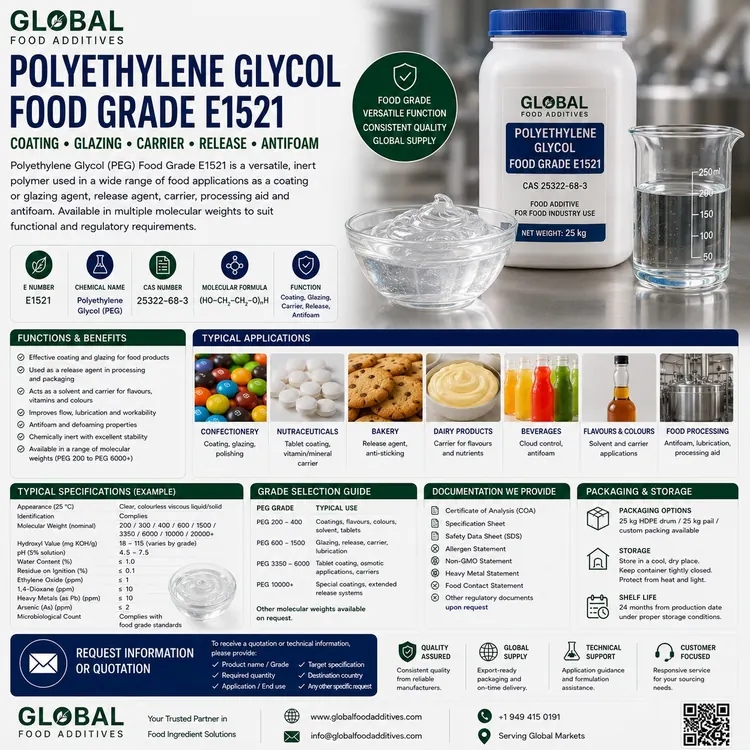
Product identity
| Product | Polyethylene Glycol Food Grade |
|---|---|
| Common names | PEG, PEG Food Grade, Polyethylene Glycol, Polyoxyethylene Glycol |
| Category | Glazing, Coating & Release Agents |
| Function | Glazing, coating, release, carrier, tablet-processing or antifoam ingredient depending on grade and permitted use |
| E / INS number | E1521 / INS 1521 |
| CAS / identity | 25322-68-3 |
| Chemical nature | Polyether polymer produced from ethylene oxide and water |
| Grade expression | Usually identified by approximate average molecular weight, such as PEG 200, PEG 300, PEG 400, PEG 600, PEG 1000, PEG 4000, PEG 6000, PEG 8000 or similar supplier grade |
| Typical form | Liquid, semi-solid, waxy solid, flake, bead, powder, emulsion or dispersion grade |
| Key buying issue | Food-grade PEG, pharmaceutical PEG, cosmetic PEG and industrial PEG are not automatically interchangeable |
Application fit
Potential use areas may include, subject to regulation and supplier documentation:
- Food tablets and compressed formats
- Confectionery surface systems
- Chewing gum and coating systems
- Vitamin and mineral preparations
- Nonnutritive sweetener systems
- Selected coating, glazing and release applications
- Processing aids where locally permitted
- Antifoam or carrier systems where approved
Industrial functionality overview
Polyethylene Glycol is valued industrially because its physical behavior changes with average molecular weight. Lower molecular weight PEG grades are typically liquids with useful solvent, humectant, carrier and viscosity-control behavior. Higher molecular weight grades are typically waxy solids, flakes, beads or powders that can contribute to coating structure, tablet processing, surface finish, controlled melting behavior and handling performance.
In food-related manufacturing, the technical objective is usually not simply “adding PEG.” The buyer must define the exact role: coating aid, binder, plasticizer, lubricant, bodying agent, dispersing aid, antifoam, release support or carrier. The correct grade depends on the product matrix, temperature, water activity, mixing system, contact time, dosing method, label requirement and country-specific food additive rules.
Functional benefits by application
Food tablets and compressed formats
PEG grades may be evaluated for tablet-related functions such as coating, binding, plasticization and lubrication. In compressed food tablets, supplements or sweetener tablets, grade choice affects surface smoothness, compression behavior, friability, dissolution profile, sticking tendency and coating flexibility.
- Can support smoother tablet surfaces and coating integrity.
- May reduce sticking during compression or coating operations.
- Can act as a plasticizer in suitable film or coating systems.
- Requires compatibility testing with active ingredients, sweeteners, minerals, flavors and colorants.
Vitamin and mineral preparations
Certain PEG grades may be reviewed as dispersing aids or carriers in vitamin and mineral systems where locally permitted. The technical focus is usually uniform distribution, manageable viscosity, wetting behavior, stability and compatibility with sensitive micronutrients.
- Supports dispersion of selected micronutrient preparations.
- May help improve uniformity in premixes or concentrated systems.
- Requires oxidation, moisture and compatibility review.
- Should be evaluated with the final carrier, matrix and packaging format.
Nonnutritive sweetener systems
PEG may be considered in some sweetener systems as a bodying, processing or flavor-support component where allowed by applicable rules. Industrial evaluation should include sensory impact, dissolution, tablet hardness, humidity response and compatibility with high-intensity sweeteners.
- Can contribute to body and processing behavior.
- May help manage uniform distribution in low-dosage sweetener systems.
- Requires careful label and regulatory review.
- Should be tested for taste neutrality and storage stability.
Coating, glazing and surface control
In coating and glazing systems, PEG grade selection influences film flexibility, surface feel, gloss, anti-sticking behavior, water interaction and process handling. It may be considered in confectionery, gum, tablets or other surface-treatment systems depending on the exact market rules and formulation design.
- Can improve surface uniformity and handling performance.
- May support anti-sticking or release behavior in selected systems.
- Higher molecular weight grades can provide waxy solid handling properties.
- Must be assessed against moisture uptake, tackiness and storage conditions.
Carrier and processing systems
PEG can function as a carrier, solubilizing aid or viscosity modifier in selected technical systems. Buyers should confirm whether the intended use is direct food additive use, indirect processing support, tablet excipient use or another regulated function.
- Can assist with uniform incorporation of minor ingredients.
- May improve process flow in concentrated systems.
- Compatibility with flavors, colors, oils, salts and actives must be checked.
- Food-grade and non-food-grade materials must be strictly separated.
Antifoam and process-control use
Some markets and applications discuss PEG for antifoam or process-control functions. This requires strict regulatory confirmation, because permitted use, maximum level and technical purpose can vary significantly by jurisdiction and food category.
- May reduce foam formation in suitable systems where permitted.
- Should be evaluated under real processing temperature and shear.
- Requires confirmation of carry-over, labeling and residue expectations.
- Not suitable for use assumptions without regulatory review.
Technical grade selection criteria
Industrial buyers should select Polyethylene Glycol Food Grade by function, not only by price. Two PEG materials with the same CAS number may perform very differently if their molecular weight, viscosity, impurity profile, physical form or compliance documentation is different.
| Selection factor | Why it matters |
|---|---|
| Mean molecular weight | Controls whether the grade behaves more like a liquid carrier, semi-solid binder or waxy solid coating component. |
| Physical form | Liquids, flakes, beads, powders, emulsions and dispersions require different dosing, melting, pumping, dry blending and storage methods. |
| Viscosity | Important for pumping, spraying, coating, mixing, filling and dispersion behavior. |
| Hydroxyl value | Used as a control parameter related to molecular weight and polymer consistency. |
| Water content | Affects stability, handling, caking risk, reaction with moisture-sensitive ingredients and final product water activity. |
| Impurity profile | Food-grade review should include ethylene glycol, diethylene glycol and other relevant residual or impurity limits according to the applicable specification. |
| Thermal behavior | Melting or softening behavior affects coating preparation, warm mixing, sprayability and solidification after application. |
| Regulatory destination | Permitted use can differ by country, food category, molecular weight, technical function and maximum use level. |
| Documentation standard | Food additive, compendial, pharmaceutical and industrial documentation packages may differ significantly. |
Specification points to request
A useful technical comparison should be based on the supplier’s current technical data sheet and batch-specific certificate of analysis. Depending on the grade, buyers may need to request the following parameters before approval:
- Product name, grade code and average molecular weight range.
- CAS number, E / INS number and declared food-grade status.
- Appearance, color, odor and physical form.
- Viscosity range at the specified temperature.
- Hydroxyl value or molecular-weight-related control value.
- pH, acidity / alkalinity or related specification where applicable.
- Water content, usually by Karl Fischer or approved internal method.
- Residue on ignition, sulfated ash or inorganic residue where specified.
- Ethylene glycol and diethylene glycol limits.
- Heavy metals or elemental impurities according to the relevant market specification.
- Microbiological limits where applicable for powder or food-contact use.
- Storage temperature, shelf-life and handling precautions.
- Packaging type, net weight, pallet configuration and container loading information.
Food-grade, pharma-grade and industrial-grade distinction
Polyethylene Glycol is sold into multiple industries, including food, pharmaceutical, cosmetic, personal care, coatings, lubricants and industrial processing. These grades may share similar chemistry but differ in permitted use, impurity limits, documentation, manufacturing controls and traceability. A low-price industrial PEG should not be substituted for a food-grade or compendial grade unless the supplier can provide the required compliance documents and the buyer’s QA team approves it for the intended use.
Food-grade review
- Confirm food additive or food-contact suitability.
- Verify permitted use in the destination country.
- Check technical purpose and maximum use level.
- Confirm labeling and declaration requirements.
- Request allergen, GMO and origin statements where needed.
Compendial or excipient review
- Check whether USP, NF, Ph. Eur. or other compendial references are required.
- Confirm that the supplied grade matches the buyer’s approved specification.
- Review impurity limits and analytical methods.
- Confirm batch traceability and change-control communication.
- Verify that the intended use is acceptable for the market.
Industrial-grade warning
- Do not assume industrial PEG is suitable for food use.
- Industrial grades may have different impurity controls.
- Documentation may not satisfy food manufacturer audits.
- Packaging may not be food-contact appropriate.
- Regulatory declarations may be unavailable or insufficient.
Supplier approval points
- Manufacturer identity and origin.
- Food safety or quality system certification.
- Lot traceability and certificate availability.
- Specification revision control.
- Lead time, MOQ and sample policy.
Processing and formulation guidance
PEG performance depends strongly on grade, temperature and the order of addition. Liquid grades can often be pumped or dosed directly if viscosity is suitable. Higher molecular weight solid grades may require melting, warming, pre-blending or controlled dispersion before use. In coating and tablet applications, process temperature, residence time, mixing intensity and cooling profile can affect finished surface quality and stability.
- Liquid grades: confirm viscosity at the actual plant temperature before designing pumps, dosing lines or filling systems.
- Solid grades: check melting or softening behavior and avoid overheating beyond supplier guidance.
- Dry blends: evaluate particle size, bulk density and segregation risk during transport and hopper feeding.
- Coatings: test film flexibility, tackiness, surface gloss, anti-sticking performance and storage behavior.
- Tablets: evaluate compression behavior, hardness, friability, dissolution, coating adhesion and lubricant balance.
- Vitamin/mineral systems: check compatibility with salts, acids, flavors, colors, antioxidants and moisture-sensitive ingredients.
- Scale-up: verify that laboratory performance remains stable under plant shear, residence time, heating and cooling conditions.
Quality, compliance and documentation
For international sourcing, documentation quality is critical. Buyers should confirm not only the product name and price, but also whether the supplier can provide complete technical, safety, regulatory and logistics documents for the destination country and buyer audit requirements.
Core documents
- Technical data sheet or product specification.
- Certificate of analysis for the available batch or lot.
- Safety data sheet where applicable.
- Manufacturing origin and country-of-origin statement.
- Shelf-life and recommended storage conditions.
- Packaging, net weight and pallet configuration.
Regulatory documents
- Food-grade declaration.
- E / INS number declaration where applicable.
- Destination-market compliance statement.
- Allergen statement.
- GMO status statement where required.
- Halal or kosher certificate if required.
Technical documents
- Molecular weight range or grade designation.
- Impurity and residual solvent statement where applicable.
- Analytical method references.
- Compendial reference if requested by the buyer.
- Change-control or specification revision statement.
- Application or processing guidance from the supplier.
Logistics documents
- Packing list and commercial invoice.
- Certificate of origin where required.
- HS code guidance subject to customs confirmation.
- Transport and storage condition notes.
- Container loading quantity and pallet dimensions.
- Import documents requested by the destination country.
Storage, handling and packaging considerations
Polyethylene Glycol should be stored according to the supplier’s specification in closed original packaging, protected from contamination, excessive heat, direct sunlight, moisture and strong odors. Liquid grades may need temperature control for viscosity and pumpability. Solid grades should be protected from caking, deformation and moisture pickup.
- Keep containers tightly closed when not in use.
- Use clean food-grade handling equipment for approved food applications.
- Follow first-expiry-first-out stock rotation.
- Confirm whether heating, melting or homogenization is required before use.
- Check whether the product is supplied in drums, IBCs, bags, cartons, pails or other export-ready formats.
- Verify that packaging is suitable for the intended regulatory and food-contact requirements.
- Inspect incoming goods for leakage, caking, discoloration, odor change or packaging damage.
Technical purchasing notes
When reviewing Polyethylene Glycol Food Grade, compare the supplier specification against the intended application, process conditions, target technical function, label expectations and destination-market rules. For industrial purchasing, the most useful inquiry normally includes the exact PEG grade, average molecular weight, physical form, quantity, packaging size, destination, delivery term and document requirements.
Buyers should avoid approving a product based only on the phrase “food grade.” A stronger approval process links the supplier’s exact grade code to the intended use, target function, regulatory market, internal specification and batch certificate. This reduces the risk of receiving a technically different PEG grade after the sample approval stage.
| Information to include | Example details |
|---|---|
| Target grade | PEG 400, PEG 600, PEG 4000, PEG 6000, PEG 8000 or supplier reference grade. |
| Application | Tablet coating, sweetener tablet, vitamin/mineral preparation, confectionery coating, release system, carrier system or antifoam use. |
| Technical function | Coating, binding, plasticizing, lubrication, release, bodying, dispersion, carrier, antifoam or process-control support. |
| Physical form | Liquid, semi-solid, waxy solid, flake, bead, powder, emulsion or dispersion. |
| Quality standard | Food-grade, compendial, buyer specification, market-specific compliance or supplier technical standard. |
| Quantity | Sample, trial quantity, drum quantity, pallet quantity, container quantity or annual contract volume. |
| Destination | Country, port, city, delivery term and import-document requirements. |
| Documents | TDS, specification, COA, SDS, food-grade statement, allergen, GMO, halal, kosher, origin, shelf-life and regulatory declaration. |
Documents to request
- Product specification or technical data sheet.
- Certificate of analysis for available batch or lot.
- Safety data sheet where applicable.
- Food-grade, E / INS or regulatory status statement where relevant.
- Origin, manufacturer, shelf-life and storage information.
- Allergen, GMO, halal, kosher or vegan statements where required.
- Packaging details, net weight and pallet configuration.
- Market-specific declarations required by the destination country.
- Statement confirming molecular weight range and physical form.
- Change-control or specification revision statement for approved repeat supply.
How to request this product
Send the product name, target PEG grade or reference specification, approximate molecular weight, intended application, target technical function, quantity, destination country, packaging preference, expected shipment date and required documents. If you already purchase Polyethylene Glycol Food Grade, attach or describe your existing specification, label, supplier reference or certificate of analysis so available options can be compared accurately.
Useful technical answers
What is Polyethylene Glycol Food Grade used for in food manufacturing?
Polyethylene Glycol Food Grade is typically discussed for selected coating, glazing, release, carrier, tablet-processing, bodying, dispersion or antifoam functions. Exact suitability depends on the grade, average molecular weight, food category, destination-market regulation, process conditions and supplier documents.
Is every Polyethylene Glycol suitable for food use?
No. Industrial, cosmetic, pharmaceutical and food-grade PEG materials may differ in impurity limits, quality systems, documentation and intended use. Buyers should approve only the exact grade supported by the required food-grade or market-specific documents.
Which PEG grade should I request?
The correct grade depends on the intended function. Liquid PEG grades are often reviewed for carrier, processing or viscosity-related functions, while higher molecular weight grades may be reviewed for waxy, solid, coating or tablet-related behavior. Send the target application and existing specification so the supplier can recommend the closest grade.
Which documents should be requested?
Buyers commonly request a technical data sheet, product specification, certificate of analysis, safety data sheet where applicable, food-grade declaration, origin statement, allergen statement, GMO statement, shelf-life information, storage conditions, packaging details and market-specific compliance declarations.
Can Global Food Additives source Polyethylene Glycol Food Grade?
Global Food Additives can review sourcing options for Polyethylene Glycol Food Grade according to target grade, average molecular weight, application, quantity, destination, packaging preference, delivery term and required documentation.
Is this product permitted in every country?
No. Food additive permission depends on destination-market rules, food category, technical purpose, maximum use level, molecular weight, label requirements and buyer responsibility. Always confirm local regulatory status before commercial use.
Tell us which Polyethylene Glycol Food Grade you need.
Send the PEG grade, approximate molecular weight, application, target function, quantity, destination country, packaging preference, delivery term and document requirements. Our team will review your inquiry and respond from orders@foodgradeadditives.com.
Your message has been received. You will be redirected to the home page.