
Saccharomyces Cerevisiae Yeast
Saccharomyces Cerevisiae Yeast is a food-grade fermentation organism used in bakery, brewing and selected food fermentation systems where manufacturers require controlled carbon dioxide generation, dough leavening, sugar metabolism, aroma development, process consistency and reliable starter-culture performance. This page is prepared for purchasing teams, R&D formulators, bakery technologists, fermentation managers, QA departments and import coordinators who need a structured starting point for specification review, sample selection, documentation collection and quotation requests.
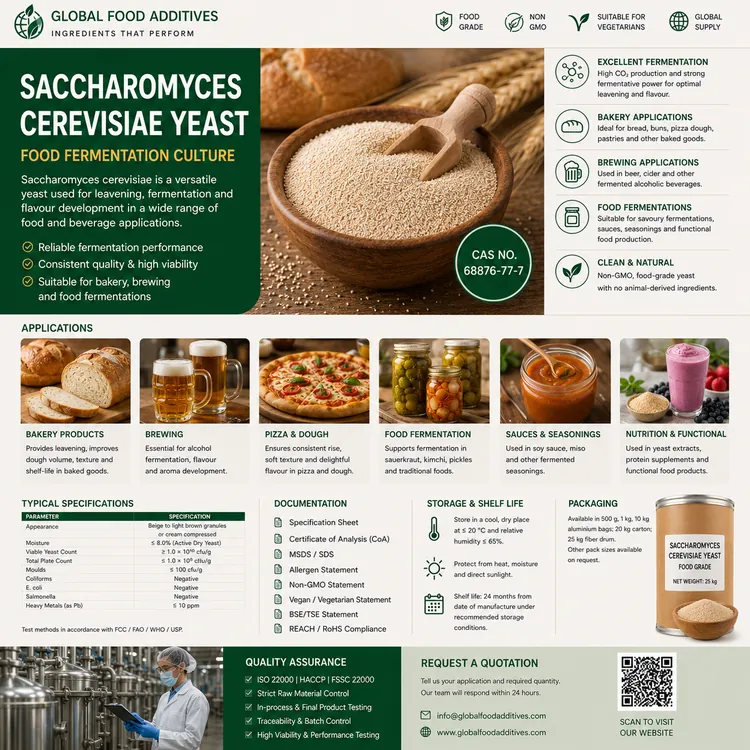
Product identity
| Product | Saccharomyces Cerevisiae Yeast |
|---|---|
| Scientific name | Saccharomyces cerevisiae |
| Common names | Baker's yeast, brewer's yeast, active dry yeast, instant yeast, fresh yeast, fermentation yeast |
| Category | Fermentation, Cultures & Bio-Protective Ingredients |
| Primary function | Fermentation culture, leavening organism, aroma-development culture and process-standardisation ingredient |
| E / INS number | Confirm by destination market, supplier documentation and intended use |
| CAS / identity | 68876-77-7 |
| Typical form | Active dry yeast, instant dry yeast, compressed fresh yeast, cream yeast, frozen yeast, freeze-dried culture, powder or blend |
| Typical activity indicators | Viable cell count, leavening power, gassing rate, fermentation rate, moisture, storage stability and strain identity |
| Typical use concept | Controlled conversion of fermentable sugars into carbon dioxide, ethanol and flavour-active metabolites |
Application fit
Potential use areas may include:
- Bread, buns, rolls, toast bread and flatbread systems
- Pizza dough, frozen dough and par-baked bakery products
- Sweet dough, laminated dough and enriched bakery systems
- Bakery sourdough systems and controlled mixed fermentations
- Brewing, ale-style fermentation and malt-based beverages
- Wine-style, cider-style and fruit-based fermentations where permitted
- Plant-based ferments, cereal ferments and savoury fermented foods
- Yeast biomass, nutritional yeast or inactive yeast applications depending on grade
Technical purchasing notes
When reviewing Saccharomyces Cerevisiae Yeast, compare the supplier specification against the intended food application, process temperature, fermentation time, target gas production, target flavour profile, substrate composition, salt and sugar level, water activity, storage requirements, label expectations and local rules. For industrial purchasing, the most useful inquiry normally includes target yeast type, viable cell count or activity requirement, strain or application category, physical form, packaging size, storage temperature, quantity, destination country and document requirements.
Industrial role and fermentation performance
Saccharomyces cerevisiae is selected in food manufacturing because it can metabolise fermentable sugars and generate carbon dioxide, ethanol and secondary aroma compounds. In bakery systems, carbon dioxide expands the dough structure and supports volume, crumb openness and texture. In brewing and beverage fermentation, yeast contributes attenuation, alcohol formation, carbonation potential, ester profile, higher alcohol profile and process reproducibility. In food fermentation systems, strain selection can influence flavour, acidity balance, gas formation, substrate conversion and overall product identity.
Leavening power
In bakery applications, yeast activity is assessed through gas production, proofing speed, oven spring, dough tolerance and finished product volume. Strong leavening power can reduce proofing time and improve line efficiency, but excessive activity may create over-proofing risk.
Fermentation kinetics
Fermentation rate depends on strain, viable count, temperature, hydration, sugar type, salt level, pH, flour quality, dough strength and oxygen availability. Industrial trials should measure activity across the complete production window.
Aroma development
Yeast can contribute bread aroma, fermented notes, fruity esters, alcohols and savoury complexity. In long fermentation, sourdough and brewing systems, strain choice can strongly influence finished flavour.
Process standardisation
Using a controlled commercial culture can improve repeatability compared with undefined natural fermentations. Standardised yeast supports predictable proofing, attenuation, flavour profile and batch release decisions.
Grade selection guide
Different yeast formats are designed for different factory conditions. The correct grade should be selected according to application, processing time, equipment, storage capacity, hydration practice, cold-chain capability and required shelf life.
| Grade or format | Industrial relevance | Purchasing note |
|---|---|---|
| Active dry yeast | Common dry form with good shelf stability, often requiring rehydration or controlled mixing depending on supplier instruction. | Confirm moisture, activity, viable count, rehydration guidance, packaging barrier and shelf-life conditions. |
| Instant dry yeast | Designed for direct addition into flour or dry mixes and fast dispersion in bakery processes. | Request dosage guidance, gas-production data, tolerance to sugar/salt and compatibility with automated dosing. |
| Compressed fresh yeast | High-moisture, high-activity form used by bakeries requiring strong fermentation performance and traditional dough handling. | Confirm cold-chain requirement, short shelf life, delivery frequency, microbiological status and handling instructions. |
| Cream yeast | Pumpable yeast suspension suitable for large automated bakeries with liquid dosing systems. | Check solids content, viscosity, microbiology, tank hygiene, agitation and delivery logistics. |
| Freeze-dried culture | Used for specialised fermentation systems, starter cultures, pilot production and selected beverage or food ferments. | Request viable cell count, strain identity, reactivation method, storage temperature and application data. |
| Brewing or beverage yeast | Selected for attenuation, flocculation, alcohol tolerance, ester profile, fermentation temperature and sensory target. | Specify beverage type, wort or juice composition, fermentation temperature, desired attenuation and flavour profile. |
| Inactive yeast or nutritional yeast | Not used for live fermentation; typically used for savoury taste, nutrition positioning or vegan flavour systems. | Confirm that the product is intentionally inactive and review flavour profile, vitamin fortification and label declaration. |
| Yeast extract or autolysed yeast | Used as a flavour enhancer, umami contributor or savoury base ingredient rather than a live culture. | Request full composition, salt content, nucleotide level where relevant, allergen/GMO status and application recommendation. |
Key specification parameters to compare
A reliable yeast offer should include more than a product name and price. Industrial buyers should compare activity, viability, microbiological quality, strain identity, format, storage stability, performance data and documentation completeness before approving a commercial grade.
| Parameter | Why it matters | Recommended buyer action |
|---|---|---|
| Viable cell count | Directly affects fermentation strength, proofing time and dosage calculation. | Request CFU or viable-cell specification and batch COA data where available. |
| Leavening power / gas production | Critical for bakery volume, proofing speed, oven spring and line consistency. | Ask for standard gassing test data or run comparative dough trials. |
| Moisture content | Influences shelf life, flowability, caking risk and microbial stability in dry yeast. | Confirm specification limits and packaging moisture barrier. |
| Strain identity | Important for fermentation profile, traceability, claims and regulatory review. | Request strain identification statement or supplier strain code where possible. |
| Microbiological purity | Contaminants can affect fermentation reliability, flavour, shelf life and food safety. | Request limits for total contaminants, coliforms, pathogens, moulds and wild yeasts as relevant. |
| Fermentation temperature range | Determines performance in cold dough, ambient proofing, warm fermentation or beverage processes. | Specify process temperature and ask for application guidance. |
| Osmotolerance | Important for sweet dough, high-sugar bakery products and enriched formulas. | Request osmotolerant yeast if sugar level is high or proofing is slow. |
| Salt tolerance | Salt can inhibit yeast activity and delay fermentation. | Test in the real formula, especially for pizza dough, crackers, savoury doughs and high-salt systems. |
| Flavour profile | Relevant for sourdough, brewing, fermented cereals and long-fermentation products. | Evaluate finished product sensory profile, not only fermentation speed. |
| Shelf life and storage | Yeast activity declines when storage conditions are not controlled. | Confirm recommended temperature, humidity protection, re-test date and cold-chain requirements. |
Application guidance by industry
Industrial bakery
In bread, buns, rolls, flatbreads and toast bread, Saccharomyces cerevisiae drives dough expansion through carbon dioxide generation. Bakeries should evaluate proofing time, dough tolerance, oven spring, crumb structure, crust colour and finished product volume.
- Useful target: predictable proofing and consistent loaf volume.
- Watch point: high salt, low temperature or old yeast can slow activity.
- RFQ note: provide flour type, sugar level, salt level, proofing time and process temperature.
Pizza dough and frozen dough
Pizza dough, chilled dough and frozen dough systems require yeast with suitable cold tolerance, freeze-thaw performance and delayed fermentation behaviour. Yeast selection should protect handling stability, proofing recovery and final crust quality.
- Useful target: controlled gas production after cold storage or thawing.
- Watch point: freezing can reduce viable yeast activity.
- RFQ note: specify fresh, chilled, frozen or par-baked process.
Sweet dough and enriched bakery
Sweet doughs contain sugar, fat, eggs, dairy ingredients or inclusions that can stress yeast. Osmotolerant yeast may be needed for brioche, sweet buns, doughnuts, panettone-style products and filled bakery items.
- Useful target: reliable rise in high-sugar formulas.
- Watch point: sugar and fat can delay fermentation and reduce volume.
- RFQ note: share sugar percentage, fat level and proofing schedule.
Sourdough and mixed cultures
In sourdough and cereal fermentations, Saccharomyces cerevisiae may be used alone or with lactic acid bacteria. Yeast contributes gas production and aroma, while bacteria may contribute acidity, flavour complexity and shelf-life effects.
- Useful target: stable fermentation with controlled flavour development.
- Watch point: yeast-bacteria balance changes with temperature, hydration and refreshment schedule.
- RFQ note: specify whether a pure yeast, sourdough starter or mixed culture is required.
Brewing and malt-based beverages
Brewing yeast selection affects attenuation, alcohol level, ester profile, flocculation, fermentation temperature and clarity. The correct strain depends on beverage type, wort gravity, target flavour and tank conditions.
- Useful target: predictable attenuation and desired aroma profile.
- Watch point: wild yeast or diastatic strains can create over-attenuation or refermentation risk.
- RFQ note: provide target beverage style, gravity, temperature and packaging method.
Plant-based and savoury ferments
Yeast may be evaluated in plant-based fermented foods, cereal bases, legume systems, savoury pastes and flavour-building fermentations. Performance depends on substrate sugars, available nitrogen, minerals, pH, oxygen and competing microflora.
- Useful target: aroma development and controlled substrate conversion.
- Watch point: plant matrices can have antimicrobial compounds or nutrient limitations.
- RFQ note: share raw material, target pH, fermentation time and heat-treatment plan.
Processing and formulation notes
Yeast activity is highly dependent on process conditions. Manufacturers should validate dosage, hydration, mixing order, dough temperature, proofing humidity, fermentation time, substrate availability, salt level, sugar level and storage conditions before scale-up. Yeast that performs well in a laboratory test may behave differently in high-speed industrial lines, cold-chain dough systems, high-sugar formulas or long fermentation schedules.
Hydration and activation
Some dry yeasts require controlled rehydration, while instant yeasts may be added directly. Incorrect water temperature, poor mixing or osmotic shock can reduce activity and create inconsistent fermentation.
Temperature control
Fermentation rate increases or decreases with temperature. Process control should include dough or mash temperature, room temperature, proofing temperature and cooling or freezing steps.
Ingredient interaction
Salt, sugar, fat, acids, preservatives, spices, enzymes, emulsifiers and antimicrobial ingredients can influence yeast activity. Always test in the full finished formula.
Scale-up validation
Commercial trials should measure proofing time, gas output, pH, aroma, alcohol formation where relevant, finished volume, texture, shelf life and batch-to-batch repeatability.
Performance and quality-control considerations
| Control point | Technical impact | Factory recommendation |
|---|---|---|
| Incoming activity test | Confirms yeast performance before production release. | Use supplier COA plus an internal gassing or dough-rise test for critical applications. |
| Storage temperature | Incorrect storage can reduce viability and shorten shelf life. | Store according to supplier instructions and record temperature exposure. |
| Water quality | Chlorine, hardness, pH and mineral balance can affect yeast hydration and activity. | Test yeast performance in actual plant water, especially for liquid or rehydrated systems. |
| Mixing order | Direct contact with salt, sugar or preservatives can inhibit yeast. | Follow supplier addition guidance and avoid local high-concentration contact. |
| Fermentation time | Under-fermentation reduces volume and flavour; over-fermentation weakens structure and consistency. | Define process windows and monitor dough height, pH, temperature or gas production. |
| Contamination control | Wild yeasts, moulds or bacteria can affect flavour, gas production and shelf life. | Maintain hygienic handling, sealed packaging, clean dosing systems and batch traceability. |
Quality, safety and compliance review
For import, customer approval and factory quality management, Saccharomyces Cerevisiae Yeast should be reviewed as a live microbial ingredient unless the grade is specifically inactive or extract-based. Buyers should confirm strain identity, intended use, food-grade status, microbiological limits, absence of objectionable contaminants, allergen status, GMO status, production substrate, carrier composition, storage requirements and destination-market regulatory classification.
Food-grade status
Confirm that the offered grade is intended for food use and not feed, technical fermentation, fuel ethanol, agricultural or laboratory use. Request a food-grade declaration and application-specific documentation.
Viable vs inactive
Live yeast, inactive yeast, nutritional yeast and yeast extract have different technical functions and label implications. The RFQ should clearly define whether viable fermentation activity is required.
GMO and strain review
Some markets and customers require non-GMO statements, strain identity information or confirmation that the organism has not been genetically modified. Confirm requirements before quotation.
Allergen and substrate review
Review production substrate, carriers and processing aids for allergen, gluten, vegan, vegetarian, halal, kosher and customer-specific requirements.
Documents to request
- Product specification or technical data sheet with strain or product type, physical form and intended use.
- Certificate of analysis for the offered batch or representative lot.
- Viable cell count, leavening power, gassing activity or fermentation performance data where applicable.
- Strain identity statement, culture purity statement or supplier strain code where available.
- Safety data sheet where applicable, especially for industrial handling and concentrated powders.
- Food-grade statement and destination-market regulatory declaration.
- Microbiological specification covering pathogens, coliforms, moulds, wild yeasts and contaminants as relevant.
- Allergen, GMO, gluten, vegan, vegetarian, halal and kosher statements where required.
- Production substrate, carrier, emulsifier or processing aid declaration where applicable.
- Shelf-life, storage temperature, humidity protection and after-opening handling information.
- Packaging details, net weight, pallet configuration, cold-chain requirement and container loading information.
- Application guidance, dosage range, rehydration instructions and process recommendations.
Packaging, storage and logistics
Yeast packaging and storage conditions depend strongly on product form. Dry yeast is typically supplied in vacuum-packed bricks, foil-laminate bags, cartons or food-grade sacks designed to protect against oxygen and moisture. Fresh compressed yeast and cream yeast require refrigerated logistics and strict stock rotation. Freeze-dried cultures may require chilled or frozen storage depending on supplier specification. For export shipments, buyers should confirm temperature-control requirements, shelf-life remaining at dispatch, palletisation, customs documents and whether the product can tolerate the expected transit conditions.
| Packaging question | Why it matters |
|---|---|
| Is the product active dry, instant, fresh, cream, frozen, freeze-dried or inactive? | Determines shelf life, storage temperature, dosing method and logistics cost. |
| What is the minimum remaining shelf life at shipment? | Important because yeast activity declines over time, especially if storage is poor. |
| Is cold-chain transport required? | Fresh and some culture formats may lose activity without temperature control. |
| Is the packaging oxygen- and moisture-protective? | Helps protect viability, flowability and fermentation performance. |
| What is the net weight per bag, carton, brick, drum or container? | Supports production batching, warehouse planning and dosing-system compatibility. |
| Are export documents available before shipment? | Reduces customs delay and speeds up customer approval. |
Commercial evaluation and cost-in-use
Yeast should be evaluated by cost-in-use, not only price per kilogram. A higher-activity yeast may provide lower dosage, shorter proofing time, stronger process tolerance and fewer rejected batches. Buyers should compare activity, viable cell count, shelf-life stability, production yield, process speed, packaging losses, documentation quality, delivery reliability and technical support before commercial approval.
Sample approval
Request a representative sample from the same grade and production site proposed for commercial supply. Test it in the actual formula and process, not only in a simplified laboratory medium.
Line trial
Validate proofing time, fermentation rate, dough handling, volume, sensory profile, shelf life and production yield under real factory conditions.
Supplier consistency
Review lot-to-lot activity, lead time, shelf-life remaining, packaging quality, documentation speed, cold-chain performance and long-term availability.
Regulatory fit
Confirm ingredient naming, culture declaration, viable status, GMO status, allergen requirements and destination-market rules before commercial launch.
How to request this product
Send the product name, target application, required yeast format, strain or performance requirement, activity requirement, dosage target, processing temperature, fermentation time, storage conditions, documentation needs, annual and first-order quantity, destination country, packaging preference, Incoterms and expected shipment date. If you already purchase Saccharomyces cerevisiae yeast, attach your current specification, COA, technical data sheet, dosage level or fermentation trial result so supplier options can be compared accurately.
Recommended RFQ checklist
- Product: Saccharomyces Cerevisiae Yeast / Saccharomyces cerevisiae
- Application: bread, pizza dough, sweet dough, frozen dough, sourdough, brewing, beverage fermentation, plant-based fermentation or inactive yeast use
- Required format: active dry, instant dry, compressed fresh, cream yeast, frozen, freeze-dried, inactive or extract-based
- Required activity: viable count, leavening power, gas-production rate, attenuation or customer-specific performance target
- Formula details: sugar level, salt level, fat level, pH, water activity, flour type, substrate or wort/juice composition
- Process details: mixing method, hydration method, proofing or fermentation temperature, fermentation time and storage conditions
- Required documents: TDS, specification, COA, SDS, strain statement, microbiology, allergen, GMO, origin, halal, kosher and storage guidance
- Regulatory market and intended label declaration
- Quantity for sample, pilot trial and commercial order
- Preferred packaging, pallet configuration and cold-chain requirements
- Delivery term, port, airport or warehouse destination
- Existing approved reference sample, competitor specification or trial benchmark if available
Useful answers
What is Saccharomyces Cerevisiae Yeast used for in food manufacturing?
Saccharomyces Cerevisiae Yeast is used as a fermentation culture in bakery, brewing and selected food fermentation systems. It supports dough leavening, carbon dioxide generation, sugar metabolism, aroma development and process consistency.
Is all Saccharomyces cerevisiae yeast the same?
No. Bakery yeast, brewing yeast, wine-style yeast, fresh yeast, instant yeast, active dry yeast, inactive yeast and yeast extract can have different functions, activity levels, storage requirements and label implications. The correct grade depends on the application.
Which yeast grade should a bakery request?
The bakery should specify active dry, instant dry, compressed fresh, cream yeast or frozen dough-compatible yeast. It should also provide sugar level, salt level, process temperature, proofing time, packaging format and target finished-product performance.
What quality parameters are important?
Important parameters include viable cell count, leavening power, gassing activity, moisture, microbiological purity, strain identity, fermentation temperature range, osmotolerance, salt tolerance, shelf life and storage conditions.
Can Saccharomyces cerevisiae be used in sourdough?
Yes, it may be used in sourdough or mixed-culture systems, but sourdough performance depends on the balance between yeast and lactic acid bacteria, flour type, hydration, temperature, refreshment schedule and process time.
Is inactive yeast suitable for fermentation?
No. Inactive yeast, nutritional yeast and yeast extract are not intended to produce live fermentation activity. They are usually used for flavour, nutrition positioning or savoury taste contribution, depending on grade.
Can Global Food Additives source Saccharomyces Cerevisiae Yeast?
Global Food Additives can review sourcing options for Saccharomyces Cerevisiae Yeast according to target application, required format, performance requirement, quantity, destination, packaging preference, cold-chain needs and documentation requirements.
Which documents should be requested?
Buyers commonly request a technical data sheet, specification, certificate of analysis, strain statement, food-grade declaration, microbiological specification, safety data sheet where applicable, allergen statement, GMO statement, origin statement, shelf-life information, storage guidance and packing details.
Is this product permitted in every country?
No. Regulatory status depends on destination-market rules, food category, viable or inactive status, intended use, label wording, strain requirements and customer responsibility. Local regulations should be verified before commercial use.
Tell us which Saccharomyces cerevisiae yeast grade you need.
Send product name, target application, required yeast format, activity requirement, quantity, destination country, packaging preference, storage conditions, delivery term and document requirements. Our team will review your inquiry and respond from orders@foodgradeadditives.com.
Your message has been received. You will be redirected to the home page.