
Sodium Saccharin
Sodium Saccharin is a high-intensity, non-nutritive sweetener used in food and beverage manufacturing for sugar reduction, calorie reduction, sweetness correction and cost-effective formulation where permitted. It delivers strong sweetness at very low use levels, making it useful in low-calorie products, tabletop sweetener systems, confectionery, beverages and selected processed foods.
Unlike sucrose, Sodium Saccharin contributes sweetness without meaningful bulk, viscosity, browning, fermentation substrate or solids contribution. Industrial formulation therefore requires more than a simple replacement calculation: successful use depends on sensory balancing, permitted use level, pH and process conditions, aftertaste management, carrier selection, label rules and batch-to-batch quality control.
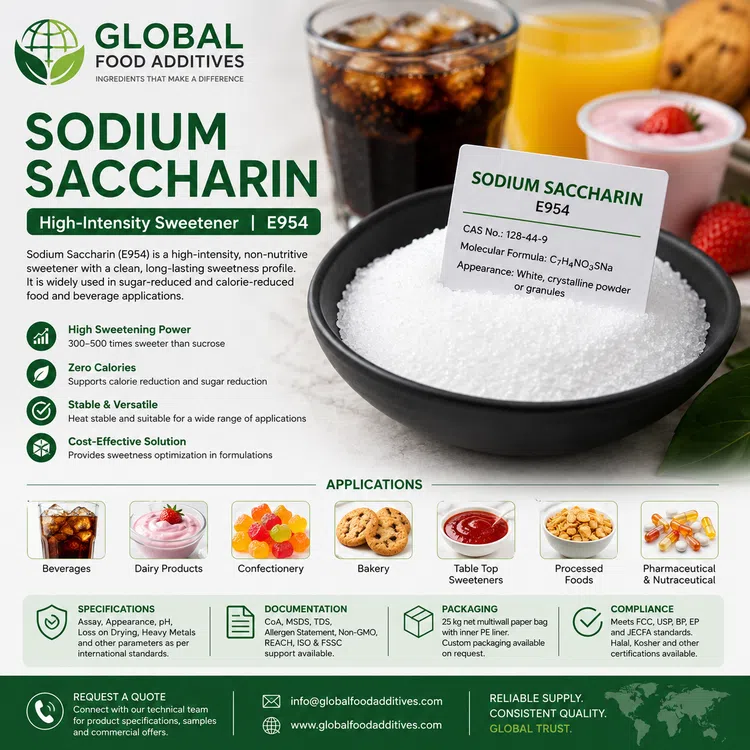
Product identity
| Product | Sodium Saccharin |
|---|---|
| Common names | Saccharin sodium, sodium saccharinate |
| Category | Sweeteners & Polyols |
| Primary function | High-intensity sweetener for sweetness design and sugar reduction |
| E / INS number | E954 / INS 954 |
| CAS / identity | 128-44-9 |
| Typical form | White crystalline powder, fine powder, granular grade or custom blend |
| Typical sensory profile | Very high sweetness intensity with possible bitter or metallic aftertaste at higher concentrations |
| Solids contribution | Low use level; does not replace sugar bulk or texture by itself |
| Use status | Confirm food category, maximum permitted level, label declaration and claims by destination market |
Application fit
Potential use areas may include:
- Carbonated and still beverages
- Instant drink powders and beverage concentrates
- Confectionery, hard candy and compressed tablets
- Chewing gum and breath-freshening products
- Bakery fillings, toppings and low-sugar systems where permitted
- Dairy desserts and flavored milk systems where permitted
- Tabletop sweetener tablets, sachets and dispenser formats
- Pharmaceutical, nutraceutical and oral-care flavor masking where applicable
Industrial function and commercial value
Sodium Saccharin is selected when a manufacturer needs strong sweetness impact with very low dosage, good formulation economy and compatibility with sugar-reduced positioning. Its high sweetness potency allows formulators to lower sugar content without adding significant calories or solids from the sweetener itself. This makes it commercially attractive in beverage concentrates, dry mixes, tabletop formats and products where the sweetener cost per finished unit is important.
For industrial purchasing teams, the critical value is not only the unit price per kilogram. The more useful comparison is sweetness cost-in-use, assay consistency, sensory performance, regulatory fit, documentation quality, packaging integrity and supplier reliability. Small differences in particle size, solubility, purity, moisture or impurity profile may affect handling, dissolution, flavor balance and batch consistency.
Technical specification points to compare
Composition and assay
- Assay or purity on the supplier's declared basis
- Anhydrous or hydrate status, where applicable
- Moisture or loss-on-drying value
- Sweetener identity and E954 / INS 954 declaration
- Compliance with buyer specification, pharmacopoeial or food additive standards where required
Impurity and safety controls
- Heavy metals and elemental impurity limits
- Organic impurity profile where specified
- Residual solvent or process-residue statement where applicable
- Microbiological limits for food and nutrition applications
- Allergen, GMO, irradiation and contamination statements where required
Physical properties
- Particle size or mesh distribution
- Bulk density and flowability
- Powder appearance, color and odor
- Solubility and dissolution rate in the target matrix
- Dusting tendency and handling behavior
Process compatibility
- Suitability for dry blending, tablets, sachets or liquid systems
- Behavior in acidic beverages and flavored syrups
- Thermal robustness for selected processed products
- Compatibility with acids, flavors, colors and preservatives
- Uniform distribution at low inclusion levels
Formulation guidance for food manufacturers
Sodium Saccharin is normally used at low inclusion levels, so accurate weighing, pre-blending and distribution control are important. For large industrial batches, many formulators prefer a pre-diluted sweetener blend or carrier-based premix to improve dosing accuracy and reduce the risk of localized over-concentration. The correct approach depends on batch size, mixing equipment, target sweetness intensity, food matrix and local regulations.
- Beverages: evaluate dissolution speed, pH stability, interaction with acids and preservatives, sweetness onset, aftertaste and compatibility with flavor systems.
- Confectionery: consider sweetness release, bitterness masking, interaction with polyols or bulking agents, heat exposure and final texture requirements.
- Chewing gum: compare particle size, release profile, blend compatibility and persistence of sweetness during chewing.
- Dry mixes: review segregation risk, carrier compatibility, flowability, dusting and uniformity in sachet or powder filling lines.
- Tabletop formats: confirm compression behavior, carrier selection, tablet hardness, disintegration time and label declaration rules.
Sensory design and sweetener blending
Sodium Saccharin can deliver strong sweetness but may show a bitter or metallic aftertaste, especially when used at higher levels or in delicate flavor systems. For this reason, industrial formulators often evaluate it in combination with other high-intensity sweeteners, acids, flavors or masking systems. Blending can improve sweetness curve, reduce aftertaste, increase roundness and help the final product taste closer to a sucrose-based reference.
Common sensory objectives
- Fast sweetness impact
- Reduced sugar or no-added-sugar positioning
- Lower calorie contribution
- Improved sweetness cost-in-use
- Balanced aftertaste and clean finish
- Flavor masking in bitter or acidic systems
Formulation challenges
- No sugar-like bulk or mouthfeel
- Possible bitter or metallic notes
- Low-dosage distribution control
- Potential label restrictions by market
- Need for matrix-specific sensory trials
- Different performance in hot-fill, cold-fill and dry systems
Quality and food safety review
A robust Sodium Saccharin sourcing review should include more than a product name and price. Buyers should confirm manufacturing grade, assay, impurity profile, microbiological status, packaging integrity, shelf life, origin, traceability and supplier change-control capability. For audited food, beverage, supplement and pharmaceutical-adjacent supply chains, documentation quality can be as important as the product itself.
Before approval, the buyer should compare the supplier specification against the intended food category, process conditions, target label market and customer requirements. If the ingredient will be used in a branded export product, regulatory and labeling review should be completed before production scale-up.
Regulatory and labeling considerations
Sodium Saccharin is identified with E954 / INS 954, but permitted use depends on the destination market, product category and maximum permitted level. Some countries may allow it in specific food categories only, while others may require special label statements, sweetener declarations or restrictions for certain consumer groups. Nutrition, sugar-reduction and calorie-reduction claims should also be validated separately from ingredient permission.
Global Food Additives can assist with supplier communication and document collection; however, final responsibility for regulatory approval, use level, product claims, finished-product labeling and market placement remains with the buyer, importer, brand owner or manufacturer.
Documents to request
- Product specification or technical data sheet
- Batch-specific certificate of analysis for available lot
- Safety data sheet in the required language or format
- Food-grade or intended-use declaration where available
- Heavy metal and impurity statement
- Microbiological specification where relevant
- Allergen, GMO, vegan, halal or kosher statements where required
- Origin, manufacturer, shelf-life and storage information
- Label draft, packaging details and pallet configuration
- Manufacturing site certification such as GMP, HACCP, ISO or FSSC where available
- Market-specific declarations requested by the destination country, customer or importer
- Change-control, traceability and recall-support information for audited supply chains
Packaging, storage and logistics
Sodium Saccharin is commonly supplied in sealed bags, cartons, drums or other supplier-specific packaging systems designed to protect the product from moisture, contamination and handling damage. Packaging choice should be matched to the customer's production scale, dispensing method, warehouse conditions and documentation requirements.
- Packaging size: confirm net weight per bag, carton or drum and whether small-pack options are available for low-volume or pilot-scale users.
- Moisture protection: request information on inner liner, sealing method and storage humidity recommendations.
- Handling: review dusting tendency, PPE recommendations and safe weighing procedures for high-intensity sweeteners.
- Transport: confirm HS code guidance, labeling requirements, country-specific import documents and any special transport classification.
- Traceability: ensure each package is clearly labeled with product name, batch number, net weight, shelf life and supplier identification.
Commercial purchasing notes
For industrial purchasing, quotation accuracy depends on the quality of the inquiry. The most useful request normally includes target grade, reference specification, required assay, quantity, destination country, Incoterms preference, packaging size, required documents and expected shipment date. If the buyer already uses Sodium Saccharin, sharing an existing COA, label, TDS or internal specification helps compare alternative suppliers more accurately.
Best-fit inquiry details
- Product name: Sodium Saccharin
- Required grade and intended food application
- E954 / INS 954 declaration requirement
- Assay, moisture and particle-size expectations
- Quantity, annual forecast and repeat-order potential
- Destination country and delivery term
- Preferred packaging and labeling language
- Required certificates and declarations
What we can coordinate
- Supplier specification comparison
- Document collection and pre-shipment review
- Packaging and logistics communication
- Export-ready quotation support
- Alternative grade or sweetener blend discussion
- Customer-specific documentation requests
How to request this product
Send the product name, target grade or reference specification, quantity, destination country, packaging preference, expected shipment date and required documents. If you already purchase Sodium Saccharin, attach or describe your existing specification, label or certificate of analysis so supplier options can be compared more accurately.
Useful answers
What is Sodium Saccharin used for in food manufacturing?
Sodium Saccharin is used as a high-intensity sweetener for sugar reduction, calorie reduction and sweetness adjustment in selected foods and beverages. It is used at low levels and does not provide the bulk or texture of sugar.
Is Sodium Saccharin the same as sugar?
No. Sodium Saccharin provides sweetness but not the full functional role of sugar. It does not replace sucrose bulk, browning, viscosity, fermentation behavior or water activity control.
Can Global Food Additives source Sodium Saccharin?
Global Food Additives can review sourcing options for Sodium Saccharin according to target specification, quantity, destination, packaging and required documentation.
Can Sodium Saccharin be blended with other sweeteners?
Yes. Depending on local regulations and product design, formulators may evaluate Sodium Saccharin with other sweeteners, acids, flavors, polyols or bulking systems to improve sweetness profile and reduce aftertaste.
Which documents should be requested?
Buyers commonly request a technical data sheet or specification, certificate of analysis, safety data sheet, origin statement, shelf-life information, label and packing details, impurity statements and market-specific declarations.
Is this product permitted in every country?
No. Food additive use depends on destination-market rules, food category, maximum permitted level, sweetener declaration, label requirements and buyer responsibility.
Tell us which food additive or ingredient you need.
Send product names, target specifications, quantity, destination country, packaging preference, delivery term, and document requirements. Our team will review your inquiry and respond from orders@foodgradeadditives.com.
Your message has been received. You will be redirected to the home page.