
Industrial Yogurt Starter Cultures
Yogurt starter cultures are selected thermophilic lactic-acid bacteria used to convert lactose into lactic acid and to build the characteristic structure, acidity, aroma and microbiological profile of yogurt. Standard yogurt cultures combine compatible strains of Streptococcus thermophilus and Lactobacillus delbrueckii subsp. bulgaricus. Industrial culture selection must also consider acidification kinetics, gel strength, exopolysaccharide production, post-acidification, flavor, bacteriophage robustness, process format, cold-chain conditions and finished-product shelf life.
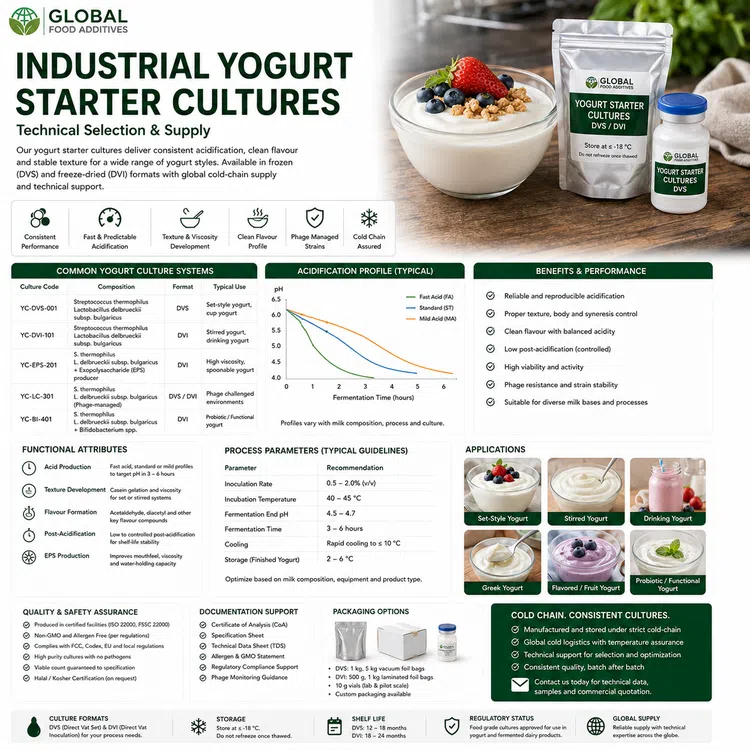
Product identity
| Product family | Yogurt and fermented-milk starter cultures |
|---|---|
| Culture type | Thermophilic lactic starter culture |
| Core microorganisms | Streptococcus thermophilus and Lactobacillus delbrueckii subsp. bulgaricus |
| Optional adjuncts | Supplier- and product-specific lactic cultures, probiotic cultures or protective cultures where permitted and validated |
| Primary functions | Controlled acidification, coagulation, texture formation, flavor development and fermentation consistency |
| Typical formats | Freeze-dried direct-vat culture, deep-frozen culture, frozen pellets, concentrated liquid or bulk-starter system |
| Activity declaration | Supplier-defined activity units, nominal treatment volume, acidification profile and/or viable-cell specification |
| CAS number | Not applicable to a living multi-strain biological culture |
| E / INS number | Generally not assigned as a conventional additive number; regulatory treatment depends on market and intended use |
Industrial application fit
Culture systems can be selected or developed for:
- Set-style yogurt fermented in the retail package
- Stirred yogurt fermented in a process tank
- Drinking yogurt and fermented dairy beverages
- Strained, concentrated and Greek-style yogurt
- High-protein fermented dairy products
- Low-fat and non-fat yogurt systems
- Sweetened and fruit-preparation yogurt
- Probiotic yogurt with approved adjunct organisms
- Lactose-reduced or lactose-free yogurt processes
- Goat, sheep, buffalo and mixed-milk yogurt
- Plant-based fermented alternatives after matrix validation
- Industrial bulk starter and mother-culture production
How the yogurt culture system functions
The two characteristic yogurt organisms operate as a cooperative fermentation system. Their exact interaction is strain dependent, but industrially selected combinations are designed to acidify milk more reliably together than either organism would perform alone under the same conditions.
Streptococcus thermophilus
- Commonly contributes strongly to early-stage acidification.
- Helps lower oxidation-reduction potential and establish favorable fermentation conditions.
- May contribute formate, carbon dioxide and other metabolites that support the partner organism.
- Influences acidification speed, mild dairy aroma and final culture balance.
- Selected strains may produce exopolysaccharides that improve body, viscosity and water retention.
Lactobacillus delbrueckii subsp. bulgaricus
- Provides proteolytic activity that releases peptides and amino acids from milk proteins.
- Supports continued acidification and characteristic yogurt development.
- Contributes to acetaldehyde and other characteristic flavor compounds.
- Strongly influences tartness and post-acidification during refrigerated storage.
- Strain selection helps determine whether the final profile is mild, balanced or strongly acidic.
Culture-system design options
| Culture profile | Primary design objective | Typical industrial consideration |
|---|---|---|
| Fast acidifying | Short incubation and high line throughput | Requires close endpoint control to avoid overshooting the target acidity |
| Mild flavor | Reduced sharpness and consumer-friendly acidity | Often paired with low post-acidification and controlled cooling |
| Aromatic | Enhanced characteristic yogurt aroma | Must be evaluated with flavors, sweeteners and fruit preparations |
| EPS-producing | Higher viscosity, body and water-holding capacity | Excessive ropiness or process sensitivity may be undesirable in some products |
| Low post-acidifying | Stable refrigerated pH and reduced late-shelf-life sourness | Especially useful for long distribution chains and mild products |
| High-protein adapted | Reliable performance in concentrated or protein-fortified milk | Must tolerate increased buffering capacity and altered gel structure |
| Phage-robust rotation | Reduced fermentation interruption risk | Requires planned rotation and plant-specific phage monitoring |
| Adjunct or probiotic blend | Additional microbial functionality or label positioning | Viability, regulatory status and shelf-life targets must be validated separately |
Commercial culture formats
| Format | Operating principle | Advantages | Control requirements |
|---|---|---|---|
| Freeze-dried direct-vat culture | Concentrated culture is added directly to the production vat | Simple dosing, reduced propagation risk and strong lot standardization | Supplier-specified frozen or refrigerated storage, rapid handling and moisture protection |
| Deep-frozen direct-vat culture | Frozen concentrate or pellets are dosed directly into the vat | High activity and rapid dispersion when correctly handled | Uninterrupted deep-frozen logistics and controlled transfer to production |
| Bulk starter | A small culture is propagated in sterile or pasteurized substrate before production use | Flexible economics and high inoculation volume | Dedicated propagation equipment, aseptic practice, phage control and strict microbiological release |
| Mother and intermediate culture | Multi-stage propagation system used to generate production starter | Traditional control over production starter volume | Highest process complexity and contamination opportunity |
| Custom premixed culture system | Starter and approved adjunct cultures supplied in a standardized combination | Simplifies multi-culture dosing and finished-product targeting | Verify each organism, carrier, activity basis and storage condition |
Culture dosage and activity basis
Yogurt starter cultures are not universally dosed by mass. Suppliers may specify treatment volume, culture activity units, production units, sachets per vat or another validated activity system. Two culture products with the same package weight may not have equivalent activity.
The result should then be checked against the supplier's permitted dosing range, milk composition, process temperature, required fermentation time and plant trial data.
Under-inoculation can increase lag time, fermentation variability and contamination risk. Excessive inoculation may shorten the process unexpectedly, alter organism balance, increase culture cost and make the endpoint difficult to control. Dose changes should therefore be validated through controlled production trials rather than used as the only remedy for process problems.
Indicative yogurt manufacturing process
The parameters below are typical industrial starting points rather than universal instructions. The approved recipe, equipment capability, supplier technical data and validated plant process must control final operation.
| Process stage | Industrial objective | Key control points |
|---|---|---|
| Milk reception | Accept suitable raw material | Microbiological quality, acidity, composition, antibiotics, inhibitors, somatic cells and sensory condition |
| Standardization | Set fat, protein and total-solids composition | Recipe accuracy, powder hydration, stabilizer dispersion and batch consistency |
| Homogenization | Control fat globules and improve physical stability | Pressure, temperature, number of stages and equipment condition |
| Heat treatment | Reduce competing microorganisms and develop milk-protein functionality | Validated time-temperature profile and adequate whey-protein denaturation |
| Cooling to inoculation | Reach the selected culture's operating range | Temperature uniformity, prevention of recontamination and minimum unnecessary holding |
| Culture addition | Disperse the correct active dose | Product identity, lot, package condition, aseptic handling and gentle uniform mixing |
| Incubation | Develop acidity, gel and flavor | Product temperature, pH curve, incubation time, agitation status and environmental hygiene |
| Fermentation endpoint | Stop at the validated acidity and structure | Online or at-line pH, titratable acidity, gel condition and time to endpoint |
| Cooling | Slow culture activity and stabilize product | Cooling rate, agitation, shear, residence time and final temperature |
| Post-fermentation handling | Add fruit, flavor or perform concentration where applicable | Hygienic design, shear, dosing accuracy and recontamination prevention |
| Filling and cold storage | Protect texture, viability and shelf life | Fill hygiene, package integrity, cold-chain continuity and finished-product release |
Indicative fermentation parameters
Many thermophilic yogurt culture systems are designed for incubation in the approximate range of 40–45°C. A common industrial endpoint is near pH 4.5–4.6, but the selected set point depends on culture, milk composition, product style, desired acidity, cooling capacity and regulatory requirements.
Parameters to define
- Inoculation temperature
- Culture dose or treatment volume
- Incubation temperature tolerance
- Time to pH 5.2, 5.0 and 4.6
- Maximum acceptable total fermentation time
- Target cut or cooling pH
- Target titratable acidity
- Cooling rate and final cold-room temperature
- Permitted pH drift during distribution
Why endpoint control matters
- Cooling does not stop culture metabolism instantaneously.
- Slow cooling can produce excessive acidification and brittle gel.
- Stirred yogurt can lose viscosity if the gel is broken too early, too late or at excessive shear.
- Different tank sizes and cooling surfaces can produce different acidification overshoot.
- Product pH should be evaluated both at the fermentation endpoint and after cooling, filling and storage.
Process requirements by yogurt type
| Product format | Culture-selection focus | Process risk |
|---|---|---|
| Set yogurt | Smooth gel, package-level consistency and low syneresis | Vibration, temperature variation and movement during gel formation |
| Stirred yogurt | Shear recovery, viscosity and controlled gel breakdown | Over-shearing, pumping damage and texture loss during cooling |
| Drinking yogurt | Controlled viscosity, clean flavor and suspension stability | Sedimentation, serum separation and excessive viscosity |
| Greek-style or strained yogurt | High-protein acidification and texture after concentration | High buffering, low yield, chalkiness and separation during concentration |
| High-protein yogurt | Acidification robustness and non-brittle dense gel | Slow fermentation, grainy texture and excessive firmness |
| Low-fat yogurt | EPS contribution, body and water retention | Weak body, thin mouthfeel and whey separation |
| Fruit yogurt | Flavor compatibility and stable post-acidification | Localized pH effects, preservative carry-over and osmotic stress |
| Plant-based fermented product | Substrate utilization, nutrient requirements and matrix-specific texture | Poor growth, off-flavor, weak gel and legal naming restrictions |
Texture and exopolysaccharide performance
Selected yogurt strains can produce extracellular polysaccharides during fermentation. These exopolysaccharides may improve apparent viscosity, creaminess, gel continuity and water-holding capacity. Their performance depends on the strain combination, milk solids, sugar profile, heat treatment, fermentation temperature, endpoint and mechanical treatment.
Potential benefits
- Improved viscosity in low-fat products
- Reduced visible whey separation
- Enhanced creaminess and body
- Improved gel recovery after stirring
- Potential reduction of stabilizer requirement
- More natural texture positioning where legally appropriate
Potential limitations
- Ropy or stringy texture at excessive expression
- Batch sensitivity to temperature and milk composition
- Reduced pumpability or filling accuracy
- Interaction with starch, pectin or gelatin systems
- Different texture after fruit preparation is added
- Possible loss of viscosity under excessive shear
Flavor and aroma development
Yogurt flavor is generated by the combined activity of the starter, milk composition, fermentation profile and storage conditions. Acetaldehyde is an important characteristic aroma compound, but the final profile also reflects lactic acid and multiple secondary metabolites. Culture systems should be selected against the complete recipe rather than assessed only in plain laboratory milk.
- Fast acidification does not automatically produce the desired flavor.
- Strong L. bulgaricus activity can increase tartness and post-acidification.
- Sweeteners and fruit preparations may mask, amplify or alter perceived yogurt aroma.
- Oxygen pickup, light exposure and packaging can affect flavor stability.
- Flavor should be assessed after manufacture and throughout the assigned shelf life.
Post-acidification control
Post-acidification is the continued production of acid after the primary incubation stage, including during cooling and refrigerated storage. Excessive post-acidification can cause late-shelf-life sourness, lower pH, brittle texture, increased whey separation and reduced survival of sensitive adjunct cultures.
| Control factor | Effect on post-acidification | Recommended action |
|---|---|---|
| Culture strain selection | Primary biological determinant | Select low post-acidifying systems for long shelf life |
| Fermentation endpoint | Late cooling increases acid overshoot | Define and monitor a precise cut pH |
| Cooling capacity | Slow cooling permits continued rapid metabolism | Validate cooling rate at maximum production volume |
| Cold-chain temperature | Higher storage temperature accelerates continued activity | Control warehouse, transport and retail temperature exposure |
| Milk buffering capacity | High protein and solids may require more acid to achieve the same pH change | Validate culture performance in the commercial recipe |
| Fruit preparation | Changes local pH, sugar concentration and water activity | Test the complete finished product, not plain yogurt alone |
Bacteriophage risk management
Bacteriophages are viruses that infect specific bacterial strains. They do not serve as useful indicators of product safety, but they can slow or stop starter activity and create serious production losses. Phage management should be designed as a plant-wide preventive program rather than a reaction after a failed vat.
Common phage entry and spread routes
- Raw milk and dairy ingredients
- Whey, yogurt residues and fermentation aerosols
- Inadequately cleaned tanks, valves and transfer lines
- Air movement between fermentation and culture-handling areas
- Operator movement, tools, hoses and mobile equipment
- Bulk-starter propagation equipment
- Waste and drain systems
Preventive controls
- Use phage-unrelated culture rotations where appropriate
- Separate culture handling from whey and waste areas
- Maintain validated CIP and environmental hygiene programs
- Control air flow and aerosol generation
- Use dedicated utensils and protected culture-addition points
- Trend acidification curves for early deviation detection
- Perform plant-specific phage screening when justified
- Maintain a documented response plan for abnormal fermentation
Culture inhibitors and raw-material compatibility
Starter cultures are sensitive biological systems. Milk that passes basic compositional tests may still contain substances capable of delaying or suppressing fermentation.
- Veterinary antibiotic residues
- Sanitizer or disinfectant carry-over
- Excessive chlorine or oxidizing residues in process water
- Preservatives carried through fruit or flavor preparations
- Abnormal milk from animal health conditions
- High bacteriophage load
- Incorrect mineral balance or extreme milk composition
- High concentrations of certain sweeteners or functional ingredients
- Insufficient nutrient availability in plant-based substrates
A culture-inhibition or antibiotic screening program should be defined according to raw-material risk, local requirements and plant experience. Failed fermentation should not be corrected only by adding more culture before the root cause is identified.
Industrial fermentation performance indicators
| Performance indicator | What it shows | Recommended use |
|---|---|---|
| Initial pH | Starting milk condition and batch consistency | Record before inoculation |
| Lag phase | Culture activation and presence of inhibition | Trend against normal production curves |
| Time to pH 5.2 or 5.0 | Early and mid-stage acidification rate | Use as an early warning for slow vats |
| Time to target pH | Total fermentation-cycle performance | Compare by culture lot, tank and milk batch |
| Maximum acidification rate | Culture kinetics under process conditions | Useful for technical comparison and scale-up |
| Titratable acidity | Total acid development and buffering response | Use with pH rather than as a replacement for pH |
| Gel firmness | Structure at the fermentation endpoint | Correlate with milk solids and heat treatment |
| Apparent viscosity | Finished-product body under defined test conditions | Specify spindle, speed, temperature and sample history |
| Syneresis | Water-holding and physical stability | Measure initially and during shelf life |
| Post-acidification | pH movement during refrigerated storage | Evaluate through the full assigned shelf life |
| Starter viability | Presence of the characteristic microorganisms | Test where required by specification, claim or regulation |
| Sensory profile | Flavor, aroma, sourness and texture acceptance | Assess in the commercial formula and package |
Common fermentation problems and technical investigation
| Observed problem | Potential causes | Investigation priorities |
|---|---|---|
| Slow acidification | Phage, inhibitors, low culture activity, low temperature, under-dosing or high milk buffering | Review pH curve, culture storage, dose, milk screening, temperature records and phage risk |
| No measurable acidification | Severe inhibition, inactive culture, incorrect product, major temperature error or phage attack | Quarantine the batch, verify culture identity and investigate before rework or additional dosing |
| Fermentation too fast | Excess culture, excessive temperature, highly active lot or process measurement error | Verify dose, calibration, temperature distribution and endpoint detection |
| Weak gel | Low protein, inadequate heat treatment, premature cooling, mechanical disturbance or unsuitable culture | Review milk solids, heat history, incubation movement and culture texture profile |
| Excess whey separation | Weak protein network, excessive acidity, low solids, vibration, shear or poor cooling | Compare endpoint, gel firmness, process movement, formulation and shelf-life conditions |
| Ropy texture | High EPS expression, process temperature or unsuitable strain profile | Review culture selection, dose, fermentation conditions and shear |
| Grainy texture | Protein aggregation, excessive heat, high minerals, rapid acidification or severe shear | Review milk preparation, formulation, acidification rate and mechanical treatment |
| Excessive sourness during storage | High post-acidification, slow cooling or cold-chain abuse | Trend pH through shelf life and review culture and logistics |
| Yeast or mold spoilage | Post-pasteurization contamination, poor filling hygiene, fruit contamination or package failure | Investigate environmental hygiene, ingredients, filling and seal integrity |
| Batch-to-batch variation | Milk composition, culture handling, process temperature, culture lot, equipment or sampling differences | Use statistical trending across raw material, culture, tank and finished-product data |
Culture-handling procedure
- Confirm the culture product name, lot number, expiry date and approved rotation before removing it from controlled storage.
- Verify that the culture has remained within the supplier-specified transport and storage conditions.
- Prepare the vat and complete all required heat treatment, cooling and hygiene checks before culture exposure.
- Open the package only at the inoculation point using hygienic handling procedures.
- Add the culture according to the supplier's instructions. Do not rehydrate, thaw or temper unless the product instructions specifically require it.
- Mix only as needed to distribute the culture uniformly without introducing avoidable contamination or air.
- Record product, lot, dose, vat, inoculation time, milk temperature and operator identification.
- Begin the validated incubation program and monitor the pH curve.
- Do not return opened or temperature-abused culture packages to stock.
Cold-chain storage and transport
Culture viability and activity can deteriorate when storage temperature is exceeded, packages absorb moisture or frozen products undergo repeated temperature cycling. The exact cold-chain specification must be taken from the individual supplier because culture formats are not interchangeable.
| Control area | Information to obtain | Industrial requirement |
|---|---|---|
| Storage temperature | Permitted range for unopened commercial product | Continuous monitoring and alarm response |
| Transport temperature | Required frozen, deep-frozen or chilled logistics condition | Qualified packaging and carrier |
| Excursion allowance | Permitted time-temperature exposure, if any | Documented assessment before use |
| Package protection | Moisture, oxygen, light and physical-damage requirements | Keep sealed until immediate use |
| Shelf life | Expiry basis at the specified storage temperature | FEFO inventory management |
| Data logging | Logger type, placement and acceptance limits | Review transport records at receipt |
| Emergency storage | Backup freezer capacity and power contingency | Documented business-continuity plan |
Industrial specification review matrix
A starter-culture specification should define biological performance and supply-chain controls in addition to standard microbiological purity. Viable count alone may not predict fermentation activity, particularly when suppliers use different strains, formats or analytical methods.
| Specification area | What to define or verify | Why it matters |
|---|---|---|
| Culture identity | Declared species and strain-system composition | Confirms suitability for yogurt identity and process design |
| Culture format | Freeze-dried, frozen, pellet, liquid or bulk starter | Determines handling, dosing and storage requirements |
| Activity basis | Treatment volume, supplier units, acidification curve or another validated activity measure | Allows correct production dosing |
| Viable population | Total or organism-specific viable count where applicable | Supports identity, consistency and regulatory or claim needs |
| Acidification performance | Time-temperature-pH profile in a defined reference substrate | Provides a functional release criterion |
| Post-acidification | Expected pH development under defined refrigerated storage | Predicts late-shelf-life flavor and texture |
| Texture profile | EPS character, viscosity contribution and intended application | Supports product-style selection |
| Phage information | Rotation group, available sensitivity data and recommended plant strategy | Reduces fermentation-failure risk |
| Carrier ingredients | Milk-derived solids, sugars, cryoprotectants or other carriers | Supports allergen, label and formulation assessment |
| Contaminating microorganisms | Coliforms, Enterobacteriaceae, yeast, mold and other applicable limits | Confirms hygienic manufacture |
| Pathogens | Absence criteria for applicable organisms and sample plans | Supports food-safety release |
| Moisture | Maximum level for freeze-dried products where specified | Influences stability and activity retention |
| Storage and transport | Temperature limits, shelf life and excursion instructions | Protects activity through the supply chain |
| Packaging | Sachet, can, pouch or other format and nominal treatment volume | Supports dosing, inventory and line planning |
Microbiological quality and release testing
The supplier's release program should be designed for concentrated living cultures. Test methods, sampling plans and limits should reflect the product format and intended application.
Potential release parameters
- Culture identity or strain-system verification
- Fermentation activity in a reference substrate
- Viable count where part of the specification
- Absence of specified pathogens
- Limits for coliforms or Enterobacteriaceae
- Limits for yeast and mold
- Moisture for freeze-dried products
- Physical appearance and package integrity
- Carrier and allergen conformity
Certificate-of-analysis review
- Confirm product code and culture rotation designation.
- Check the lot number against each physical package.
- Review production and expiry dates.
- Verify storage-temperature declaration.
- Confirm that results have specification limits.
- Review functional-activity release where provided.
- Check authorized quality approval.
- Verify that the CoA represents the shipped lot.
Supplier qualification
Starter cultures are high-impact process inputs. Supplier approval should cover biological identity, manufacturing controls, contamination prevention, cold-chain capability and change management.
Quality-system information
- Legal manufacturer and culture-production site
- Food-safety plan and HACCP controls
- Relevant ISO or GFSI-recognized certification
- Strain-bank and seed-lot control system
- Identity and purity verification procedures
- Environmental-monitoring program
- Freeze-drying or freezing process controls
- Cold-storage monitoring and alarm systems
- Traceability and recall capability
- Complaint, deviation and CAPA system
- Change-notification policy
- Business-continuity and backup-production arrangements
Common declarations
- Culture composition statement
- Food-grade and intended-use declaration
- Carrier and processing-aid declaration
- Milk allergen and cross-contact statement
- GMO status of strains and production materials
- Animal-origin and BSE/TSE statement
- Irradiation statement
- Halal and Kosher certificates where required
- Country-of-origin statement
- Regulatory status for the destination market
Documents to request before commercial approval
- Current technical data sheet and product specification
- Representative certificate of analysis
- Batch-specific certificate of analysis for each shipment
- Culture species and strain-system declaration
- Activity, dosage and nominal treatment-volume information
- Reference acidification profile
- Storage, transport and temperature-excursion instructions
- Shelf-life statement
- Microbiological specification and test-method references
- Carrier and processing-aid declaration
- Allergen and cross-contact statement
- GMO and irradiation statements
- Animal-origin and BSE/TSE statement
- Regulatory compliance declaration
- Halal and Kosher certificates where required
- Quality-system certificates
- Packaging specification and shipping configuration
- Phage-rotation guidance where available
- Change-control and advance-notification commitment
Regulatory and product-identity considerations
Starter cultures are living processing microorganisms rather than conventional chemical additives. Their legal treatment, labeling and permitted use depend on the destination market, product name, culture composition, whether viable organisms remain at the end of shelf life and whether probiotic or protective claims are made.
Codex fermented-milk reference
Codex CXS 243-2003 characterizes yoghurt by the symbiotic cultures of Streptococcus thermophilus and Lactobacillus delbrueckii subsp. bulgaricus. The standard also addresses viable cultures, composition, fermented-milk categories and products heat treated after fermentation.
The Codex standard specifies a minimum total population of 107 CFU/g for the microorganisms constituting the starter culture in yoghurt, with applicability through the date of minimum durability under the stated storage conditions. The viability requirement does not apply where the product is heat treated after fermentation.
United States yogurt standard
Under 21 CFR 131.200, standardized yogurt is produced with a characterizing bacterial culture containing Lactobacillus delbrueckii subsp. bulgaricus and Streptococcus thermophilus. The current standard also addresses pasteurization before culture addition, finished-product pH and labeling related to live and active cultures.
The U.S. standard requires a finished-product pH of 4.6 or lower within 24 hours after filling. Separate requirements apply where a live-and-active-cultures statement is used or where organisms are inactivated after fermentation.
Probiotic and bio-protective positioning
A yogurt starter culture should not automatically be marketed as probiotic or bio-protective. These functions require specifically identified strains, suitable evidence, legal authorization and validated survival or performance in the finished product.
For probiotic applications
- Identify organisms to the required taxonomic level.
- Define the target count at manufacture and end of shelf life.
- Evaluate oxygen, acidity and cold-storage survival.
- Confirm compatibility with the yogurt starter.
- Verify permitted claims in the destination market.
- Test the finished product rather than relying on inoculation dose.
For protective-culture applications
- Define the target spoilage organism or process risk.
- Use strain-specific evidence under relevant product conditions.
- Confirm that sensory quality is not adversely affected.
- Do not use the culture as a substitute for hygienic manufacture.
- Validate performance throughout the assigned shelf life.
- Verify regulatory and labeling requirements.
Packaging and international logistics
Yogurt cultures may be supplied in sealed sachets, pouches, cans, cartridges or frozen containers. Package size is often linked to nominal milk-treatment volume rather than simple net weight.
| Logistics parameter | Information to confirm |
|---|---|
| Package format | Sachet, pouch, can, pellet container or other commercial system |
| Nominal capacity | Milk volume treated per package under the reference process |
| Minimum order | Packages, cartons, insulated shippers or full logistics units |
| Transport condition | Frozen, deep-frozen or chilled requirement and permitted range |
| Refrigerant system | Dry ice, phase-change material, mechanical refrigeration or qualified alternative |
| Temperature logger | Logger type, location, start procedure and acceptance review |
| Transit validation | Maximum qualified duration and seasonal shipping configuration |
| Customs planning | Product classification, import permit, biological documentation and cold-storage access |
| Delivery term | Incoterm, named place, cold-chain responsibility and risk-transfer point |
| Emergency response | Procedure for delay, damaged shipper or temperature excursion |
Commercial comparison method
Culture quotations should be evaluated by cost per treated production volume and cost per acceptable finished kilogram, not by package weight alone. The technically cheapest culture can become the most expensive option if it increases incubation time, texture losses, batch failures, phage risk or product returns.
| Comparison factor | Commercial question |
|---|---|
| Nominal treatment volume | How many liters of production milk does one package treat? |
| Actual plant dose | Does the commercial process require the reference dose or a higher dose? |
| Fermentation time | How does the culture affect tank occupancy and daily throughput? |
| Texture yield | Does the culture reduce stabilizer use, whey loss or rejected product? |
| Post-acidification | Does the culture support the required shelf life and flavor? |
| Phage strategy | Are suitable rotation options and technical support available? |
| Cold-chain cost | Are insulated shipping, refrigerant, logging and customs storage included? |
| Shelf life | Does the remaining life at delivery match inventory consumption? |
| Technical support | Is process troubleshooting, scale-up and application support available? |
| Supply continuity | Are backup lots, alternate production sites and emergency shipments available? |
Recommended trial and approval workflow
- Define the product style, recipe, milk source, process equipment, target fermentation time, texture, flavor and shelf life.
- Screen candidate culture systems using the supplier's technical data and regulatory documentation.
- Conduct laboratory trials in the actual standardized milk or plant-based base.
- Record complete pH curves rather than only starting and final pH.
- Measure viscosity, gel firmness, syneresis, flavor and post-acidification.
- Compare cultures after fruit, sweetener, flavor and stabilizer addition.
- Run pilot trials using representative heat treatment, homogenization, cooling and shear.
- Complete an industrial trial at maximum or representative vat volume.
- Evaluate finished product throughout the intended shelf life in the final package.
- Approve the culture product, dosage, storage, rotation and operating window before routine production.
RFQ information required for accurate culture selection
| RFQ category | Recommended information |
|---|---|
| Finished product | Set, stirred, drinking, strained, high-protein, low-fat or other yogurt type |
| Base material | Cow, goat, sheep, buffalo, mixed milk or plant-based substrate |
| Composition | Fat, protein, total solids, sugar, stabilizers and other relevant ingredients |
| Heat treatment | Validated milk time-temperature program |
| Homogenization | Pressure, stages and process position |
| Incubation | Target temperature, expected fermentation time and vat volume |
| Endpoint | Target pH and titratable acidity |
| Texture | Mild, firm, creamy, ropy, non-ropy, high viscosity or drinkable |
| Flavor | Mild, traditional, aromatic, low-acid or another sensory target |
| Post-acidification | Maximum acceptable pH movement through shelf life |
| Adjunct cultures | Probiotic or protective organisms and required end-of-life count |
| Phage program | Existing rotation system, recent failures and available plant monitoring |
| Production volume | Vat size, daily throughput, annual milk volume and production frequency |
| Culture format | Freeze-dried direct-vat, deep-frozen, pellet or bulk-starter preference |
| Storage capability | Available freezer temperature, backup power and inventory space |
| Destination | Country, airport, port or complete delivery location |
| Documentation | CoA, specification, regulatory, allergen, GMO, Halal, Kosher and quality certificates |
How to request yogurt starter cultures
Send the finished-product type, milk or plant base, batch volume, incubation temperature, target pH, required fermentation time, texture, flavor, post-acidification target, adjunct organisms, culture format, annual production volume, storage capability, destination and required documents. Where available, include a representative process flow, recent pH curve, product specification and description of any current fermentation problem.
Frequently asked questions
Which microorganisms define a standard yogurt culture?
Standard yogurt cultures contain compatible strains of Streptococcus thermophilus and Lactobacillus delbrueckii subsp. bulgaricus. Additional microorganisms may be included where permitted, but they do not replace the need to evaluate legal product identity in the destination market.
What does a yogurt culture control?
The culture influences acidification speed, incubation time, gel formation, viscosity, syneresis, aroma, sourness, post-acidification and microbiological consistency. Its effect must be evaluated with the milk, recipe and process.
What is a direct-vat culture?
A direct-vat culture is a concentrated starter added directly to the production batch without intermediate propagation. It can be supplied freeze-dried or frozen and is dosed according to supplier-defined activity or treatment volume.
Is culture dosage determined by package weight?
Not necessarily. Industrial cultures are frequently standardized by activity units or nominal treatment volume. Packages with similar weights may have different activity, strains and recommended milk capacities.
What incubation temperature is used for yogurt?
Many thermophilic yogurt systems operate at approximately 40–45°C, but the approved temperature must come from the supplier's data and plant trials. Temperature affects acidification speed, organism balance, flavor and texture.
Why is yogurt fermentation slow?
Potential causes include bacteriophages, antibiotic or sanitizer residues, incorrect culture storage, low dose, unsuitable temperature, high milk buffering, equipment error or contamination. The complete pH curve and process records should be reviewed before changing dose.
What is an EPS-producing culture?
It contains strains capable of producing extracellular polysaccharides during fermentation. These materials can increase viscosity, creaminess and water retention, although excessive expression may create a ropy texture.
How is post-acidification reduced?
Use a suitable low post-acidifying culture, stop fermentation at the validated endpoint, cool rapidly and maintain the cold chain. The result should be confirmed through full shelf-life testing.
What is a yogurt culture rotation?
It is a planned alternation of culture systems selected to reduce bacteriophage disruption. Effective rotations should use phage-unrelated strains and be supported by supplier data and plant monitoring.
Can a dairy yogurt culture be used in a plant-based product?
It may be technically evaluated, but performance can differ because plant substrates have different sugars, proteins, minerals, buffering capacity and nutrients. Product naming and labeling also require separate regulatory review.
Are all yogurt cultures probiotic?
No. Standard starter organisms perform fermentation, but a probiotic position requires specifically identified strains, evidence, regulatory compliance and adequate viable population in the finished product.
How should starter cultures be stored?
Store and transport each culture at the exact supplier-specified temperature. Minimize time outside controlled storage, protect freeze-dried products from moisture and evaluate every temperature excursion before use.
Which CoA information is most important?
Review product code, lot, manufacture and expiry dates, storage requirement, microbiological purity, activity or viable count where specified, package identity and authorized quality release.
Can Global Food Additives source custom culture systems?
Global Food Additives can review standard or application-specific systems against yogurt style, milk composition, process temperature, texture, flavor, post-acidification, phage rotation, culture format, destination and documentation requirements.
Send your yogurt process and culture-performance requirements.
For an accurate recommendation, include the yogurt type, milk or plant base, batch volume, incubation temperature, target pH, expected fermentation time, texture, flavor, post-acidification target, culture format, storage capability, destination and required documents. Our team will review your inquiry and respond from orders@foodgradeadditives.com .
Your message has been received. You will be redirected to the home page.